
Deposition Preparation Checklist for Personal Injury Cases

Were you hurt in an accident? Did you file a claim? If so, you may have to give a deposition. That can feel scary, but you can get ready for it. This personal injury deposition guide shows you how.
You will learn how to prepare for a personal injury deposition one step at a time. You will see the questions most people get. You will also learn what happens after it ends.
Good personal injury deposition preparation matters. One law firm says your deposition can affect your settlement leverage. It can also change how your future care and lost wages are valued. A few hours of prep can protect your whole case.
What Is a Deposition?
A deposition is a meeting where you answer questions. You give sworn testimony under oath. That means you promise to tell the truth, as you would in court.
Most depositions are oral depositions. The other side’s lawyer asks questions aloud, and you answer aloud. A court reporter types every word. These reporters use special machines that can keep up with very fast talking. Later, the words become a written deposition transcript.
The person who answers the questions is called the deponent. In most injury cases, the plaintiff gets deposed. The plaintiff is the person who got hurt. The defendant is the person or company being sued. The defendant often gets deposed too.
Depositions are part of the pretrial discovery process. Discovery is the time when both sides trade facts before trial. For the defendant, your deposition is often the first real chance to hear your story in your own words.
Who Will Be There?
Here is who you may see at a deposition:
- Your personal injury attorney. Your lawyer sits next to you the whole time.
- Opposing counsel. This is the lawyer for the other side. Most of the time, it is an insurance defense attorney paid by the insurance company. You may also hear the term insurance defense counsel.
- The court reporter or stenographer. This person records every word.
- A notary public or officer. This person swears you in. Under FRCP Rule 28, only someone the law allows can administer the oath. Often, the court reporter does this job.
- A legal videographer. In a videotaped deposition, this person runs the camera.
- An interpreter. If English is not your first language, you can ask for one. Tell your lawyer early.
In-Person and Online Depositions
Some depositions happen in a law office. Others happen online. Many depositions now take place over video, often on Zoom, while others are still held in lawyers’ offices. A remote deposition via Zoom works a lot like an in-person one. Some firms use Microsoft Teams and Webex instead. FRCP Rule 30(b)(4) lets a deposition happen by phone or video if both sides agree or a judge orders it.
In New York, It Is Called an EBT
New York uses a different name. There, a deposition is an examination before trial (EBT). New York EBTs follow CPLR 3106 through 3117. They also follow the Uniform Rules for the Conduct of Depositions (22 NYCRR Part 221). If your case is in New York, New York EBT preparation uses the same steps you will read below.
The Rules That Control Depositions
Rules tell everyone what they can and cannot do. Federal court cases follow the Federal Rules of Civil Procedure (FRCP). Here are the ones that matter most.
| Rule | What It Does in Simple Words |
| FRCP Rule 26 | Sets what each side can ask for in discovery. |
| FRCP Rule 30 | Covers depositions where people answer out loud. |
| Rule 30(b)(6) | Lets you depose a company. The company picks a person to speak for it. |
| Rule 30(d)(1) | Sets a deposition time limit of one day of seven hours, unless the sides agree or a judge says otherwise. |
| Rule 30(e) | Lets you read the transcript and fix mistakes. |
| FRCP Rule 32 | Explains when a deposition can be used in court. |
| FRCP Rule 34 | Covers requests for production of documents. |
| FRCP Rule 35 | Allows the other side to ask for a medical exam. |
| FRCP Rule 37 | Allows sanctions for failing to appear. |
| FRCP Rule 45 | Covers subpoenas, which are orders to show up. |
| FRCP Rule 56 | Covers summary judgment, a way to end a case early. |
The Federal Rules of Evidence also matter. These rules decide what proof a court can use.
- FRE 612: If you use a paper to jog your memory, the other side may get to see it.
- FRE 613: A lawyer can show that you said something different before.
- FRE 801(d)(2): The other side can use your own past words against you. This is called an opposing party’s statement.
- FRE 804: Old testimony can be used if a witness cannot come to trial. A deposition can replace live testimony when a witness is no longer available.
State vs. Federal Deposition Rules
Most injury cases are in state court. State vs. federal deposition rules can be different. Here are a few examples:
- California deposition rules are in the California Code of Civil Procedure, starting at §2025.010.
- Texas oral deposition rules are in Texas Rule of Civil Procedure 199.
- Florida deposition rules are in Florida Rule of Civil Procedure 1.310.
- New York uses the CPLR rules listed above.
Your lawyer will know which rules apply.
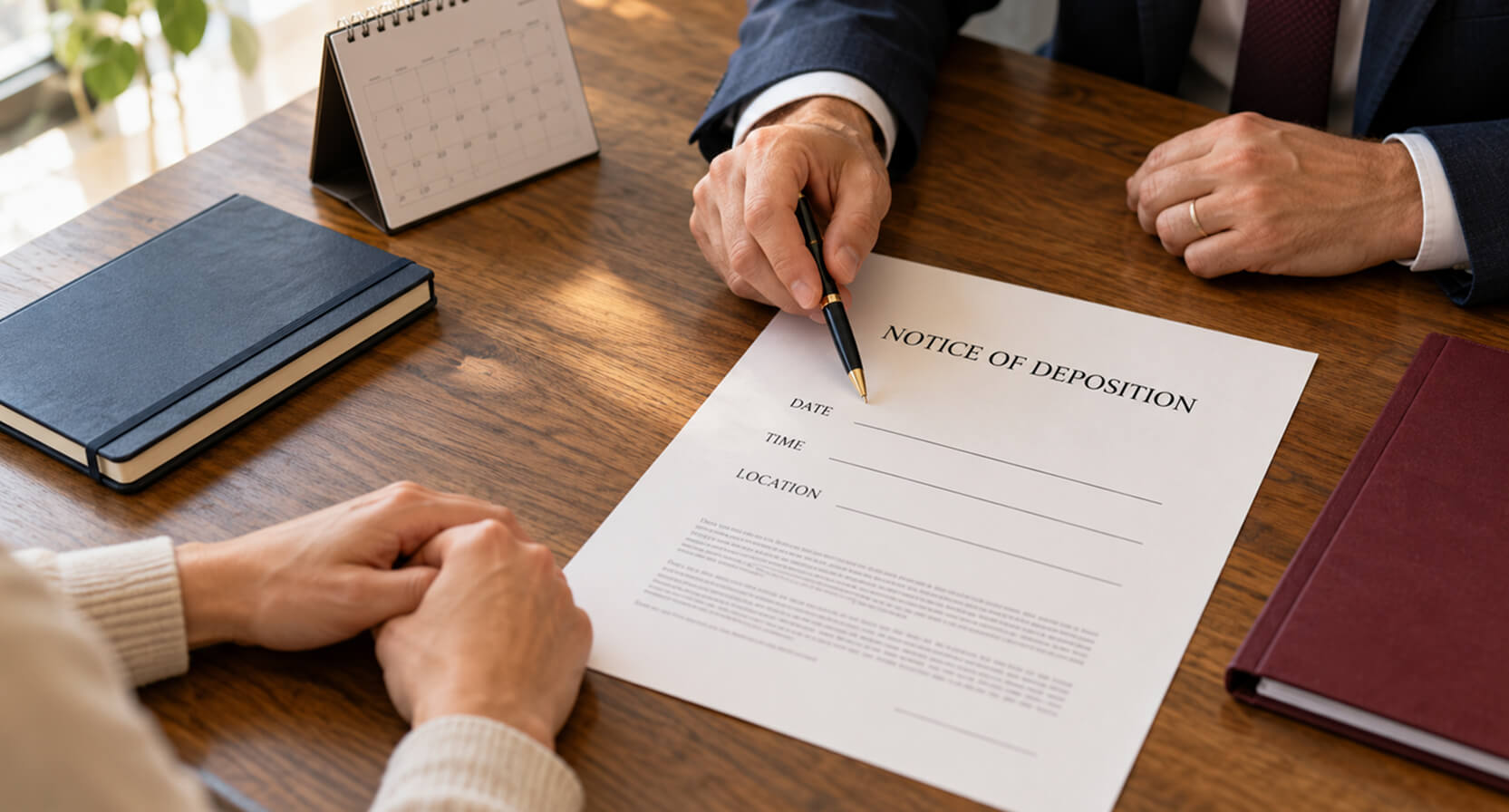
Step 1: Read Your Notice of Deposition
You will get a notice of deposition. This paper tells you the date, time, and place. Read it with your lawyer.
A witness who is not part of the case gets a deposition subpoena. That is a court order to show up. Sometimes the order also says to bring papers. That is called a subpoena duces tecum. If a lawyer wants a deponent to bring documents, they must use a subpoena duces tecum or a Rule 34 notice.
Deposition Scheduling and Location
The lawyers usually handle deposition scheduling and location. It may be at a law office, a court reporting office, or online.
What if the date does not work for you? Rescheduling a deposition is often possible. Tell your lawyer right away. Do not just skip it. If you miss it, the other side can file a motion to compel a deposition. A judge could order you to attend. You could also face a penalty.
How Long Does a Deposition Take?
People often ask, “How long does a deposition take? On average, one lasts a couple of hours. It can be shorter or longer, depending on the case. In federal court, the limit is seven hours unless the sides agree to more time.
Deposition Costs
Deposition costs include the court reporter, the transcript, and sometimes video. So who pays for the deposition transcript? Most of the time, the side that sets up the deposition pays the court reporter. Each side then buys its own copy. In many injury cases, your law firm pays these costs up front. Ask your lawyer how it works in your case.
Step 2: Meet With Your Lawyer
Never walk into a deposition cold. Set up a deposition preparation meeting with an attorney. This is also called a pre-deposition client meeting or a witness preparation session.
One paralegal suggests setting this meeting or call several days ahead. That way, the lawyer can answer your questions and explain what to expect. One trial lawyer says he spends two hours or more preparing clients, even for simple injury cases.
Your Talks Are Private
What you say to your lawyer is protected. This is called attorney-client privilege. The other lawyer cannot ask what you and your lawyer talked about. Your lawyer’s notes and plans are also protected by the work product doctrine.
Step 3: Review Your Records
Next comes a case file review before deposition. Your answers should match what is already on paper. Lawyers often go over police reports and medical records with clients. They also make a list of likely questions.
Here is what to review:
- Police report review: Read the police or accident report. Look for any mistakes.
- Medical records review: Go over your medical records and bills.
- Interrogatory answers review: Interrogatories are written questions you already answered under oath. Your deposition answers should match them.
- Requests for production and requests for admission: These are papers you sent or answered in discovery.
- Bill of particulars: In New York, this paper lists your injuries and claims.
- Incident report: Stores and businesses often write one after someone falls.
- Photos: Look at vehicle damage photos and pictures of your injuries.
HIPAA and Your Medical Records
HIPAA is a law that keeps health records private. To get your records, the other side needs your okay. In injury cases, your lawyer will usually send medical authorizations to the defense so they can get copies of your records.
Step 4: Build Your Timeline
A clear accident timeline and chronology of events helps you remember. Think in three parts: before, during, and after.
One firm suggests setting aside quiet time to think about three things: your life before the accident, the accident itself, and your life after it. That includes what doctors say about your future care.
If you hurt more than one body part, make an injury chronology by body part. One article suggests walking through when pain first showed up for each injury. Then follow the treatment for each body part. Know the onset of symptoms for each one. For example, did your back hurt right away? Or did it start two days later?
Step 5: Practice With Your Lawyer
Practice helps you stay calm. Ask your lawyer for mock deposition practice. Your lawyer will act like the other side and ask you deposition practice questions.
Good practice includes anticipating defense questions. It also includes preparing for hostile questioning. Some lawyers are friendly. Others are pushy. Both can be tricky.
Know Common Defense Attorney Deposition Tactics
Here are some defense attorney deposition tactics to watch for:
- Friendly chat. The lawyer acts nice so you relax and talk too much.
- Silence. The lawyer stays quiet after you answer. You may feel the need to fill the gap. Do not.
- Fast questions. The lawyer speeds up so you answer without thinking.
- Same question, new words. The lawyer asks the same thing again to see if your answer changes.
- Putting words in your mouth. One firm warns that lawyers are good at asking leading questions that hint at the answer they want. Do not let them fool you.
Step 6: Stay Off Social Media
This step is huge. The defense will look at your social media posts during litigation. That includes Facebook, Instagram, and TikTok. One firm warns that insurers look for statements made at the scene and for social media posts and photos. It advises staying off social media while your claim is open.
A photo of you smiling at a party can be twisted. It may look like you are not hurt. Insurers may also use surveillance evidence. They may hire a private investigator to film you in public.
But do not delete old posts. Deleting proof can count as spoliation of evidence. That can hurt your case badly. Your lawyer may send a litigation hold letter. It tells both sides to save all proof. Ask your lawyer before you change any account.
Step 7: Plan Your Deposition Day
Use a deposition day checklist so nothing gets missed.
What to Bring to a Deposition
Keep it simple. Here is what to bring to a deposition:
- A photo ID
- Your glasses, if you need them to read
- Any papers your lawyer asks you to bring
- Water and a small snack, if allowed
Do not bring anything else unless your lawyer says so. No notes during deposition. One lawyer says you can write details down ahead of time to help your memory. But you cannot use those notes during the deposition. Remember FRE 612. If you read a paper to refresh your memory, the other side may get to see it.
What to Wear to a Deposition
Think clean and simple. One firm says to dress as you would for church or a relaxed business meeting. You don’t need a suit or formal dress. That is what to wear to a deposition. Skip loud logos, flashy jewelry, and hats.
The Night Before and the Morning Of
Sleep well, skip alcohol and drugs, and plan your route around traffic. Plan to get there 15 to 30 minutes early. If you take medicine that makes you sleepy, tell your lawyer.
Tips for a Virtual Deposition
Virtual deposition etiquette matters too:
- Find a quiet, private room.
- Test your internet, sound, and video the day before.
- Use a good camera and lighting setup for remote depositions. Put a lamp in front of you, not behind you.
- Keep your camera at eye level.
- Turn off your phone and close other apps.
- Do not have anyone else in the room unless the lawyers agree.
Managing Deposition Anxiety
Deposition anxiety is normal. Almost everyone feels nervous. Take slow breaths. Remember that your lawyer is right there. You are not on trial. You are just telling what happened.
Common Personal Injury Deposition Questions

Most common personal injury deposition questions fall into a few groups. Knowing them ahead of time takes the surprise out.
Background and Personal History Questions
The deposition usually starts with easy background and personal history questions. You may be asked your full name, where you have lived for the past 10 years, and how far you went in school.
You will also be asked about your employment history. Where have you worked? What did you do there? How much did you earn?
Expect questions about prior lawsuits and workers’ compensation claims. Lawyers often ask whether you have been part of other lawsuits or legal claims, such as workers’ comp. They will also ask about your prior accidents and claims history.
Medical History Questions
Next come medical history questions. The biggest ones are about prior injuries and pre-existing conditions.
One lawyer says you will likely be asked about past injuries, and it is fine to describe them. If you do not remember any, say that as far as you know, you had none.
Do not hide old injuries. In one example, a defense lawyer spent 20 minutes on a client’s past back treatment. Because she had prepared, she knew what the records showed and answered correctly.
Having an old injury does not ruin your case. If the accident made it worse, that is called aggravation of a pre-existing condition. The law also has the eggshell plaintiff doctrine. It means the at-fault person must take you as they find you, even if you were easier to hurt than most people.
The lawyer will also ask about any injuries you sustained after the accident. Did you get hurt again later? Be honest about that too.
Questions About the Accident
The lawyer will ask you to describe the accident scene. Expect questions like these:
- Where were you going?
- What were the weather and road conditions?
- What was the lighting and visibility like?
- How fast were you going? Speed and distance estimates are hard, so do not guess.
- Where on your car was the point of impact?
- Were you wearing a seatbelt? Seatbelt use comes up in most car cases.
- Were you on your phone? Expect cell phone use and distracted driving questions.
- Have you been drinking? Alcohol or drug use questions are normal. Just answer honestly.
- Did anyone get a ticket? Expect traffic citation questions.
- Was there dashcam footage or store video?
- Who saw it happen? Share witness contact information if you have it. Eyewitness testimony can help your case.
The lawyer will also ask about statements made at the accident scene. Even saying “I’m sorry” can be used against you. You will also be asked about any recorded statement to insurance company staff. Tell your lawyer ahead of time if you talked to an insurance adjuster. This happens a lot with major auto insurers (State Farm, GEICO, Allstate, Progressive).
Why Crash Forces Matter
Defense lawyers study the injury mechanism and accident forces. They want to know how your body moved in the crash. One article explains that the injuries you claim need to match the forces of the crash. You may be asked things like how many impacts you heard.
Your lawyer will help you show injuries consistent with the impact. Some cases use a biomechanical engineer, a human factors expert, or an accident reconstruction expert to explain what happened.
Fault Questions
Every injury case is based on negligence (duty, breach, causation, damages). In plain words, someone had to be careless, and that carelessness had to hurt you. Many questions test liability and causation. That means who is at fault and whether the accident caused your injuries.
The defense may also argue comparative negligence. That means they say you were partly at fault. In many states, this can lower the money you get. So think before you answer questions about what you could have done differently.
Questions About Your Injuries and Treatment
Be ready to give a list of treating physicians. You may have more than one treating physician, such as:
- An orthopedic surgeon for bones and joints
- A neurologist for nerves, the brain, and headaches
- A chiropractor for spine care
- A pain management physician for long-term pain
- A physical therapist for rehab
- A radiologist who reads your scans
You will be asked about your full medical treatment history. That includes MRI and X-ray findings, surgical recommendations, and prescription medications.
Watch for These Trouble Spots
One plaintiff lawyer lists three trouble spots in these depositions. Gaps in treatment, multiple injuries, and treatment the lawyer sent the client to.
- Gaps in medical treatment: Did you stop seeing the doctor for a while? Know why. Maybe you had no ride, no insurance, or no time off work.
- Delay in seeking treatment: Did you wait days to see a doctor? Be ready to explain why.
- Attorney-referred medical treatment: The defense may ask how you found a doctor. Your lawyer will help you answer this truthfully.
- Treating on a lien basis: Some doctors wait to get paid until the case ends. This is set up with a letter of protection or medical lien.
- Physical therapy compliance: Did you go to every visit? If you missed some, know why.
Future Care
You may also get questions about future medical treatment. Has a doctor said you will need more care? Have you reached maximum medical improvement (MMI)? That means you are as healed as you are likely to get. Has a doctor given you a permanent impairment rating? Some cases use a life care planner to list future care needs. A legal nurse consultant may help lawyers read your medical records.
Many injuries also affect the mind. Be ready to talk about PTSD and counseling after an accident. Also mention sleep disruption after injury if you have trouble sleeping.
Questions About Your Damages
Damages are the losses you want to be paid for. Proving damages is a big part of your deposition. There are two main kinds: economic and non-economic damages.
Money Losses (Economic Damages)
- Lost wages testimony: How much work did you miss? How much pay did you lose?
- Loss of earning capacity: Can you still do your old job? Will you earn less in the future? A vocational expert or forensic economist may help show this.
- Medical bills and out-of-pocket expenses: Think about copays, rides to the doctor, braces, and home changes.
One firm notes you may be asked about other costs. These include paying for help, changing your home, or getting rides to medical visits.
You may also be asked about health insurance and collateral sources. These are other payments, like health insurance, that covered some bills. In many states, the collateral source rule keeps these payments from lowering what the at-fault side owes. Rules differ by state.
Some states use personal injury protection (PIP) and no-fault insurance. In New York, some claims must meet a serious injury test under New York Insurance Law §5102(d). In one New York case, the plaintiff claimed an injury under the “90/180 day” category and was questioned about missed work. If Medicare paid any bills, the Medicare Secondary Payer Act may require you to repay Medicare.
The defense may also bring up your duty to mitigate damages. That means you must take reasonable steps to improve, like following your doctor’s advice.
Life Losses (Non-Economic Damages)
This part is about how the injury changed your life. Your pain and suffering testimony should be honest and clear. Do not make it bigger or smaller than it is.
- Describing pain levels: Use a 0 to 10 scale. Say what makes it better or worse.
- Impact on daily activities: What is hard now? Getting dressed? Driving? Carrying groceries?
- Activities of daily living limitations: These are basic tasks like bathing, cooking, and cleaning.
- Loss of household services: Do you need help with yard work, chores, or child care?
- Hobbies and recreation before the accident: Did you run, fish, garden, or play sports? What can you still do?
- Loss of enjoyment of life: What parts of life do you no longer enjoy?
- Emotional distress and mental anguish: Do you feel scared, sad, or worried now?
Good before-and-after life testimony paints a clear picture. Use real examples. For instance: “Before the crash, I played ball with my son every night. Now I can’t throw without pain.”
How to Answer Deposition Questions: Deposition Dos and Don’ts

These are the most important deposition dos and don’ts. They are also the best deposition tips for plaintiffs.
One firm boils it down to three rules. Listen to the whole question. Think about your answer. Then give a true answer that is as short as you can make it.
Do: Answer Truthfully and Concisely
Always answer truthfully and concisely. The truth is your best friend. Short answers are safer than long ones.
Do: Listen to the Entire Question
Listen to the entire question before you speak. Do not start answering halfway through. Wait for the lawyer to finish.
Do: Pause Before Answering
Pause before answering. Count to two in your head. A short pause gives your lawyer time to react. This means letting your attorney object first.
Understand Objections
Your lawyer may say, “Objection, form.” This is an objection to form. It means the question is poorly worded. Under FRCP Rule 30(c)(2), objections must be short and cannot coach you. Most of the time, you still answer after an objection.
Sometimes your lawyer will instruct you not to answer. This is rare. It usually protects private talks with your lawyer. If your lawyer says not to answer, do not answer.
Don’t: Guess or Speculate
Don’t guess or speculate. One firm lists guessing, instead of just saying you don’t know, as the top mistake defense lawyers use against people. If you do not know, say so.
Use “I Don’t Recall” Answers the Right Way
“I don’t recall” answers are fine when they are true. But do not use them to dodge. If you say “I don’t recall” too often, it may look like you are hiding something.
Don’t: Volunteer Extra Information
Avoid volunteering information. Answer only the question asked. If the lawyer asks, “Do you know what time it was?” the answer is “Yes” or “No.” Let them ask the next question.
Watch for Tricky Questions
- Leading questions suggest the answer. For example: “You were going pretty fast, weren’t you?” Only agree if it is true.
- Compound questions ask two things at once. For example: “Did you see the car and hit the brakes?” Ask the lawyer to split it up.
Do: Ask for Clarification
Asking for clarification is always okay. If a question is confusing, say, “I don’t understand.” Asking to repeat the question is fine too.
Do: Speak Out Loud
The court reporter can only type what you say. So focus on giving verbal answers instead of nodding. Say “yes” or “no,” not “uh-huh.”
Documents and Exhibits
The lawyer may show you deposition exhibits. These are papers, photos, or records. Take your time. Read the whole thing before you answer. You may refresh your recollection with documents when the lawyer hands you one.
Fix Mistakes Right Away
Did you realize you made a mistake? Correcting a mistake on the record right away is the best move. Just say, “I want to fix an answer I gave earlier.”
Stay Consistent
Consistent testimony builds trust. If your deposition answers do not match what you say later, you create prior inconsistent statements. The other side can use them to impeach you with deposition testimony at trial. That means showing the jury you changed your story. This can hurt your witness credibility.
Make a Good First Impression
First impressions at deposition matter. One lawyer notes that the defense lawyer writes a report to the adjuster about how the client looks and how believable they seem. Another firm says it’s important to present your side clearly and come across as a presentable plaintiff.
Being presentable means being polite, calm, and honest. Watch your deposition demeanor and body language. Sit up. Look at the person asking. Do not roll your eyes or cross your arms. Good deposition etiquette also means never arguing with the other lawyer.
Stay Calm Under Questioning
Staying calm under questioning is key. If you feel upset, pause. Take a breath. Your lawyer is there to protect you.
Take Breaks When You Need Them
You may take breaks during a deposition. Just do not ask for one while a question is waiting. Answer first, then ask. Conferring with counsel during breaks is normal. But in some courts, lawyers cannot coach you mid-question. When the lawyers agree to stop the record, it is called going off the record.
What Happens on Deposition Day
Most depositions follow the same order:
- You arrive early. You meet your lawyer before it starts.
- Swearing in the witness. The court reporter asks you to promise to tell the truth.
- The usual deposition stipulations. The lawyers may agree on basic rules. For example, they may agree to save some objections for trial.
- Ground rules. The other lawyer explains how things will work.
- Questions. The other lawyer asks most of the questions. This is the longest part.
- Follow-up. Your lawyer may ask a few questions to clarify things.
- The end. Your lawyer will say whether you want to read and sign the transcript.
After the Deposition: Your Next Steps
Reviewing the Deposition Transcript
After a few weeks, the transcript is ready. Reviewing the deposition transcript is an important job. Read every page. Look for typos or wrong words.
Read and Sign Deposition Rules
A read-and-sign deposition lets you review the transcript. Under Rule 30(e), you must ask to read and sign before the deposition ends. You then have 30 days from when the court reporter says the transcript is ready. Any changes must go in a signed statement with the reasons.
That signed list is called an errata sheet. Errata sheet corrections can fix spelling or typing errors. Courts do not agree on how far these changes can go. Some allow only small fixes. Others allow bigger changes, even ones that contradict the original answer.
New York gives you more time. Under CPLR 3116(a), if the witness does not sign and return the transcript within 60 days, it can be used as if it were signed.
Why You Cannot Change Your Story Later
Some people try to fix a bad answer later with a sworn paper. Courts often block this under the sham affidavit doctrine. This matters for deposition testimony in summary judgment. The other side may use your words to try to end the case early. That is why getting it right the first time matters.
Post-Deposition Debrief With Attorney
After it ends, debrief with an attorney. Talk about what went well. Talk about what worries you.
In New York, lawyers often send post-EBT demands for more information, usually within 30 days after the deposition.
Your lawyer’s team will likely make a page-line deposition summary. It lists key answers by page and line number. A deposition digest is a similar short summary.
What the Insurance Company Does Next
The defense lawyer will send a defense report to the insurance adjuster. The insurer then evaluates the case after the deposition. A strong deposition can increase the settlement value. It can also give you more leverage in settlement. Plaintiff depositions can help your settlement position and help defeat motions that try to end your case.
Many cases go to mediation and settlement negotiations next. A mediator is a neutral person who helps both sides reach an agreement.
The Independent Medical Examination (IME)
After your deposition, you may need an independent medical examination (IME). Rule 35 allows this in federal court. One New York firm says that after the EBT, you will most likely see a doctor picked by the insurance company. Treat the IME like your deposition. Be honest and consistent.
If Your Case Goes to Trial
Using a deposition at trial is common. A lawyer may use it to test your story. If a witness cannot come, lawyers may be reading a deposition into the record. In New York, CPLR 3117 lets any party use a deposition to challenge a witness’s trial testimony. This is why consistency between deposition and trial testimony matters so much.
Other Depositions in Your Case
You are not the only one who gets deposed. Your lawyer may depose the at-fault driver.
In a trucking case, your lawyer may use Rule 30(b)(6). A corporate representative deposition in trucking cases lets your lawyer question the trucking company about safety rules, driver training, and logs.
Doctors get deposed too. A treating physician deposition records what your own doctor thinks. A medical expert witness may also give an expert witness deposition. These are often videotaped and played at trial.
Deposition Tips by Case Type
Each case type brings its own questions. One well-known deposition guide sorts its question lists by case type. It covers vehicle, premises, products, and medical malpractice cases.
Vehicle Cases
- Car accident deposition: Expect questions about speed, lanes, signals, and seatbelts.
- Truck accident deposition: Expect questions about blind spots, the truck’s size, and where you were.
- Motorcycle accident deposition: Expect questions about your helmet, gear, riding skill, and license.
- Pedestrian accident deposition: Expect questions about crosswalks, signals, and what you wore.
- Bicycle accident deposition: Expect questions about lights, bike lanes, and hand signals.
- Rideshare accident deposition: Expect questions about the app, the driver, and where you sat.
Property and Other Injury Cases
- Slip and fall deposition: Expect questions about your shoes, the floor, and where you were looking.
- Premises liability deposition: A key issue is actual and constructive notice. Did the owner know about the danger? Or should they have known?
- Construction accident deposition: Expect questions about safety gear, training, and who was in charge.
- Dog bite injury deposition: Expect questions about what you did before the bite and whether you knew the dog.
Complex and Serious Cases
- Medical malpractice deposition: Expect detailed questions about your care and what the doctor told you.
- Nursing home abuse deposition: Family members are often asked about visits, care, and changes they saw.
- Wrongful death deposition: Family members share what their loved one meant to them. These are hard. Your lawyer will help you get ready.
Preparing a Minor for Deposition
Children can be deposed too. Preparing a minor for deposition takes extra care. Use simple words. Keep practice short. Let the child know it is okay to say “I don’t know.” Ask your lawyer whether a parent can be in the room.
For Lawyers and Paralegals: The Attorney Deposition Prep Workflow
This section is for legal teams. A clear attorney deposition prep workflow keeps things from slipping.
Paralegal Deposition Checklist
A good paralegal deposition checklist starts early. One litigation paralegal suggests three first steps once the date is set. Put it on the calendar. Tell the client. Then ask about any recent treatment so those records and bills can be ordered right away.
- Calendaring the deposition date and any prep meetings
- Ordering updated medical records and bills
- Sending the client prep letter
- Booking the court reporter, videographer, and interpreter
- Building the exhibit and prep binders
Deposition Preparation Timeline
A simple deposition preparation timeline might look like this:
| When | Task |
| 4 weeks before | Confirm the date, order records, send the prep letter |
| 2 weeks before | Review the file, draft the outline, send the prep video |
| 1 week before | Hold the prep meeting and mock deposition |
| 1 to 2 days before | Make a quick call to answer last questions |
| After | Debrief, review the transcript, draft the summary |
Outlines, Memos, and Themes
Start with a deposition preparation outline. Many firms keep a plaintiff deposition outline template to save time. Write a short deposition preparation memo for the file.
Know your theory of the case. That is the simple story of why your client should win. Then pick two or three case themes for deposition. For example: “She did everything right, and her life changed anyway.
Final Thoughts
A deposition is not a test. It is your chance to tell what happened. With good prep, you can stay calm and clear. Follow this checklist. Work closely with your lawyer. And always tell the truth.