
Request for Production of Documents for Personal Injury Claims

If you get hurt in an accident, paper trails matter a lot. A personal injury claim often depends on proof. One strong tool for finding proof is the request for production. This guide explains what it is. It also shows what to ask for. And it shows how to use this tool correctly.
What Is a Request for Production of Documents?
A Request for Production of Documents is a discovery request. One side of a lawsuit uses it. It makes the other side hand over papers, records, or objects. People also call it a document request. Or a notice to produce. Or a demand for inspection. The Federal Rules of Civil Procedure cover this tool in Rule 34. Texas has its own version of this rule, too.
This request can ask for tangible things. Not just paper. It can also ask for electronically stored information, or ESI. This means emails, texts, and computer files. The goal is simple. Each side wants to see what the other side has. Lawyers call this the item’s possession, custody, or control.
A request for production is part of the discovery process. Both sides exchange facts and evidence before trial. People also call this written discovery, since most of it is on paper. Every court follows a set of civil discovery rules. These rules set each side’s discovery obligations. They also set the scope of discovery. That means how far a request can reach. A request must aim at relevant and admissible evidence. That means proof a court would allow at trial.
Request for Production vs. Interrogatories vs. Requests for Admission
People often mix up these three tools. Here is a simple way to tell them apart.
| Tool | What It Does |
| Request for production | Asks the other side to hand over documents or objects |
| Interrogatories | Written questions, the other side must answer in writing |
| Requests for admission | Asks the other side to admit or deny a fact |
Interrogatories and requests for production often work well together. For example, a plaintiff may first use written interrogatories. This asks which insurance company covers the defendant. Then the plaintiff sends a request for production. This gets a copy of the actual policy. Form interrogatories are ready-made questions. Many courts already have them on file. This saves time. In Texas, attorneys more often rely on custom-drafted interrogatories built around the facts of the case, though standard sets exist for some claim types.
This process shows up in many kinds of claims. It applies to a motor vehicle collision case. It applies to a slip-and-fall case, too. The same goes for a medical malpractice case, a wrongful death case, a product liability case, a premises liability case, and even a food contamination injury case.
Requests for admission work a bit differently. Each part of the claim gets its own line. One line might ask the defendant to admit fault. This tool helps narrow down what both sides actually disagree about.
Legal Basis for Requests for Production
Rules shift a little by jurisdiction. But the core idea stays the same.
- The Federal Rules of Civil Procedure, under Rule 34, control document requests in federal court.
- The Texas Rules of Civil Procedure govern document requests in Texas state courts. TRCP 196 is the main rule covering requests for production, inspection, and entry onto property.
- TRCP 196.1 lets a party serve a request for production no later than 30 days before the discovery period ends. Each item or category must be described with reasonable detail.
- TRCP 196.2 sets the deadline for a response. This is 30 days after service, or 50 days if a defendant is served before their answer is due.
- TRCP 196.4 covers electronically stored information. The requesting party must name the ESI and state the format they want it in.
- TRCP 192.3 sets the general scope of discovery in Texas. It allows discovery of anything relevant and not privileged, including items within a party’s possession, custody, or control.
- TRCP 190 sets Texas discovery control plans, called Level 1, Level 2, and Level 3. These plans shape how long the discovery period runs and how broad discovery can be.
Rules differ by court. So always check your local court rules. Also, check the civil procedure rules in your own state.
Why Requests for Production Matter in Personal Injury Cases

Discovery is not just a formality. It is often where a personal injury lawsuit is actually won.
They reveal key evidence. A police report can show what happened. So can an insurance file or a repair record. These papers can also show who was at fault.
They support the injury claim. Medical bills show how badly someone was injured. So do doctor notes and therapy records.
They build stronger settlement leverage. Strong proof, found early, often pushes both sides toward a fair deal. This matters a lot for pain and suffering damages. These are hard to prove without clear documentation of medical expenses. They also matter for loss of earning capacity, which requires solid pay records.
They avoid surprise at trial. Once a document is requested and handed over, it becomes part of the case record. Neither side can pull out a surprise document mid-trial.
What Documents Can Be Requested in a Personal Injury Case
The list of items you can ask for is wide. It should stay tied to the real facts of your case. Here are the documents most often requested.
Documents Commonly Requested From the Defendant
- Insurance policy documents and proof of insurance coverage limits are often held by the insurance carrier or handled by a claims adjuster
- The accident report, police report, or incident report filed after the crash
- Photographs of injuries or the scene, plus surveillance footage or dash cam video
- Maintenance records and repair records for the vehicle or property involved
- Vehicle inspection reports, especially in truck accident cases
- Employment records for a commercial driver, including training files
- Reports of past, similar complaints against the same defendant, especially when the defendant is a corporate defendant, such as a trucking company or retail chain
- Company manuals or safety rules tied to the incident
- Correspondence records, including internal notes about the case
Documents Commonly Requested From the Plaintiff
- Medical records and medical bills are usually gathered from every treating physician
- Wage statements, pay stubs, or tax returns for a lost wages claim
- Photographs of injuries as they healed over time
- Past medical history, when it relates to the current injury
- Text messages and emails about the accident or injury
- Witness statements collected after the incident
Requesting Electronically Stored Information (ESI)
More discovery now happens online. This is often called e-discovery. It covers emails, cloud files, and text messages. A good request asks for these files in a usable digital format. Not just printed copies. Courts expect both sides to save this data early. This step is called a litigation hold. It starts as soon as a claim looks likely. Losing or deleting this data can lead to a claim of spoliation of evidence. That can hurt the party that lost the file. In Texas, this issue falls under TRCP 196.5, which covers the destruction or change of evidence.
How to Draft a Request for Production in a Personal Injury Case
Writing a strong request takes some care. Follow these steps.
- Caption the document correctly. List the court, case number, plaintiff, and defendant at the top.
- Add definitions and instructions. Define broad terms like “document” or “you.” This avoids confusion later.
- Write clear, specific requests. Skip vague terms like “any and all.” Name the exact categories of documents you want.
- Set a deadline. Most rules give 21 to 30 days to respond. State this clearly as your document production deadline.
- Say how documents should be produced. Ask for paper copies, digital files, or an in-person inspection and copying session. Many requests attach a document schedule. This is a simple list of where and when items must be brought.
- Add a certificate of service. This proves the request reached the other party.
- Sign and serve the request on the other side’s attorney. If the party has no attorney, serve the party directly.
Once the other side answers, someone must still do a careful document review. This means verifying that all responsive documents were received. Responsive documents are the ones that actually match the request. Nothing important should be skipped.
Common Mistakes to Avoid
- Forgetting to set a clear document production deadline
- Writing requests that are too broad, which almost always draws an objection to discovery
- Skipping instructions for a privilege log
- Copying a generic template without fitting it to your case
- Forgetting to send a supplemental production when new facts turn up
How to Respond to a Request for Production of Documents
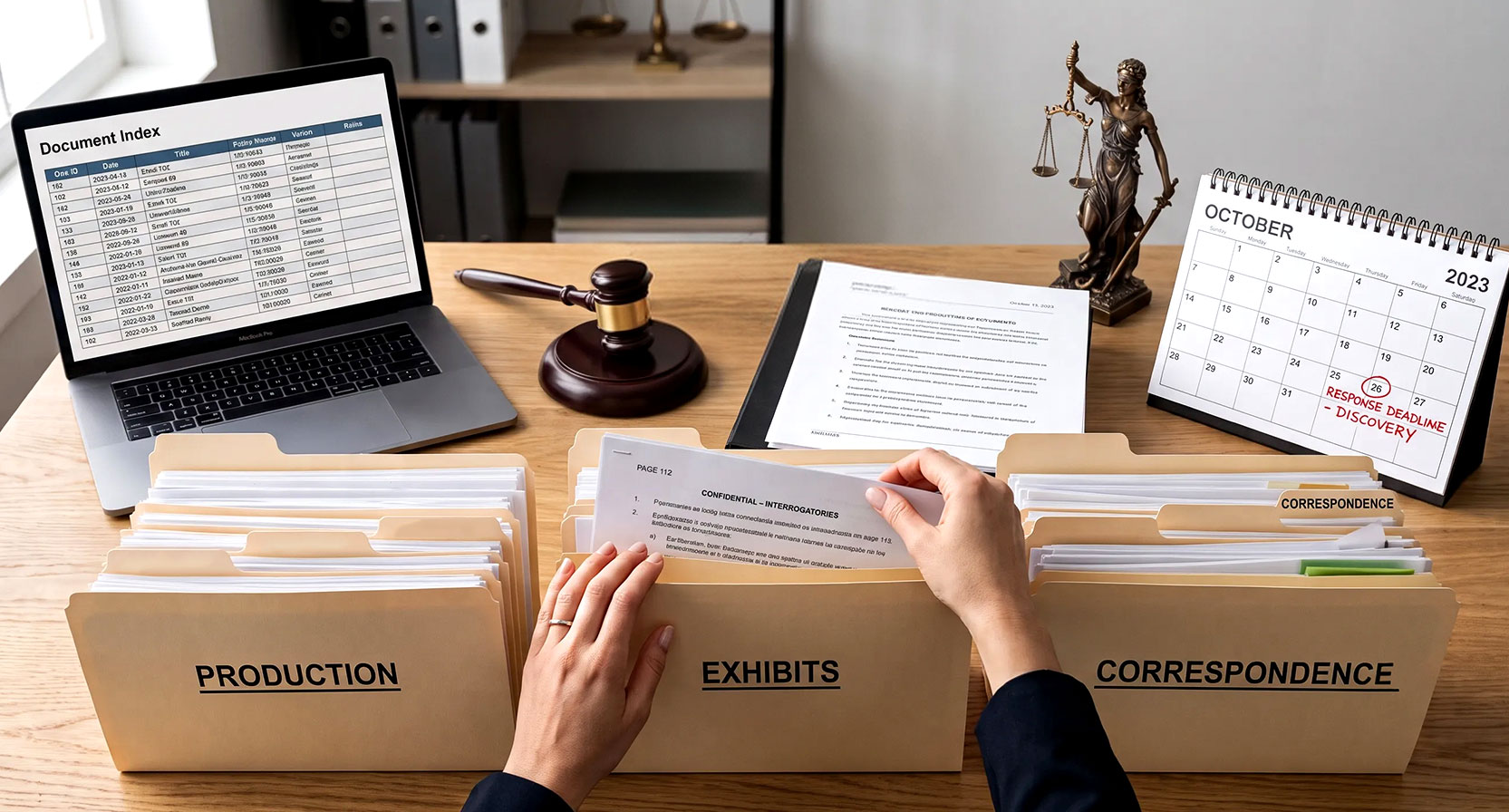
Once you get a request, you must respond honestly and on time.
Follow the format rules. Answers must be sorted to match the requests. This tells the other side which document matches which item. It stops a “document dump,” in which a party hands over thousands of files without an order. Courts do not like this.
Choose to produce, object, or both. You can hand over the item. Or raise a legal objection to discovery. Or do both at once for different parts of the request.
Use a privilege log when needed. Say you are withholding something due to the attorney-client privilege or the work-product doctrine. Then you must explain why in writing. This is often done with a formal privilege log. It must include enough detail, such as the date, author, and topic. This lets the other side judge if the privilege is fair.
Grounds for Objecting to a Document Request
Common, valid reasons to object include:
- The document is covered by the attorney-client privilege
- The document is covered by the work product doctrine
- The request is too broad and fails the proportionality in the discovery standard
- The request costs more effort than it is worth for the case
- The item would not lead to discoverable evidence
Courts expect good faith discovery. Both sides must try to work out issues honestly. Objections should not be used just to stall. If you skip an objection during discovery, you may lose it later at trial. This is called a waiver of objections.
What Happens If a Party Ignores the Request?
Ignoring a document request rarely ends well. Say a party misses documents or misses the discovery deadline. Then the other side can ask a judge for a court order compelling production. If that order is ignored as well, courts can impose discovery sanctions. These can include:
- Fines against the party or their lawyer
- An adverse inference, where the jury is told to assume the missing item would have hurt that side’s case
- Loss of the right to use certain evidence at trial
- In serious cases, loss of the whole claim or defense, under failure to respond, sanctions
Motion to Compel: When the Other Side Won’t Produce Documents
Sometimes a discovery dispute cannot be worked out through simple back-and-forth. When that happens, a party can file a motion to compel.
Before filing, most courts want the attorneys to try to fix it themselves first. This step is called a meet-and-confer. If that fails, the motion goes to the trial judge. The judge reviews both sides of the case and issues a ruling. If the judge agrees, the court issues a court order compelling production. Ignoring that order can bring discovery sanctions fast.
State-by-State Rules and Deadlines
Rules shift depending on where the case is filed. Here is a short comparison, with a closer look at Texas.
| State or Court | Governing Rule | Typical Response Time |
| Federal courts | Rule 34, Federal Rules of Civil Procedure | 30 days |
| Texas | TRCP 196 and TRCP 196.2 | 30 days, or 50 days for a defendant served before their answer is due |
| Maryland | Maryland Rule 2-422 | No set numeric limit on requests |
| California | California Code of Civil Procedure, California Civil Discovery Act | 30 to 35 days, depending on how it was served |
| Virginia | Virginia Supreme Court Rule 4:9 | 21 to 28 days |
| Georgia | O.C.G.A. section 9-11-34 | 30 days |
| New York City courts | Local civil procedure rules and case orders | Set by local rule and a judge |
| Florida civil courts | Florida discovery rules | Typically 30 days |
Texas deserves a closer look, since its deadlines and structure differ from those of many other states.
- TRCP 196.1 sets the last day on which a new request for production may be served: no later than 30 days before the close of the discovery period.
- TRCP 196.2 gives the responding party 30 days to answer, or 50 days if the request lands before the defendant’s answer is due.
- TRCP 190 places most personal injury cases in Level 2, which typically sets the discovery period at about 180 days from the first required disclosures.
- TRCP 204 governs requests for an independent medical examination, which the defense often makes once the plaintiff’s medical records are in the case.
- Texas district courts and county courts at law may also add their own local court rules, so always confirm the exact discovery cutoff date set in your case management order.
How Requests for Production Fit Into the Bigger Discovery Picture

A request for production rarely stands alone. It usually works with other tools during the pretrial discovery stage.
- Interrogatories gather basic facts in writing.
- Requests for admission narrow down disputed facts.
- Deposition testimony lets each side question a witness under oath. The person being asked, called the deponent, gives oral deposition testimony. This gets typed up word-for-word into a deposition transcript.
- A subpoena duces tecum can compel a non-party to produce records. This includes a hospital or an employer.
- An expert witness disclosure reveals who each side plans to call as an expert witness. It also shows what they will say. This often rests on expert opinion reports, supporting treatises, and journal literature.
- An independent medical examination lets the defense have its own doctor examine the plaintiff. This exam is often scheduled via a formal, deposition-style notice letter sent well before the exam date.
Once all this evidence is in hand, both sides are ready to begin real trial preparation. Or for real settlement negotiations. Many personal injury cases settle once strong evidence clarifies liability and the calculation of damages.
Every one of these tools ends with its own paper trail. One case file might hold a signed Request for Admission. It might hold a written Interrogatory Response. It might hold a formal Expert Report. And it might hold a general Discovery Response. All of this sits next to the papers produced through the request for production itself.
Key Terms to Know
- Pleading requirements: the rules for what must be included in a lawsuit or an answer when it is first filed.
- Summary judgment motion: a request asking the court to decide part or all of a case without a trial.
- Bates numbering: a system that stamps each page of produced documents with its own number. This keeps files in order.
- Document retention: a party’s duty to keep records that the case might need. Don’t throw them away.
- Chain of custody: the record of who handled a piece of evidence, and when. It proves the item was not changed.
- Redacted documents: files in which private details are blacked out before they are handed over.
- Compensatory damages: money intended to compensate for real losses, such as medical bills and lost wages.
- Punitive damages: extra money a court may add to punish reckless or harmful conduct.
- Comparative negligence: a rule that cuts an injured person’s payout if they were partly at fault. In Texas, this idea goes by the name proportionate responsibility.
- Duty of care breach: the legal failure at the root of most negligence claim cases.
- Causation evidence: proof that ties the defendant’s conduct straight to the plaintiff’s injury.
Frequently Asked Questions
What is the difference between a request for production and a subpoena?
A request for production goes to a party already in the lawsuit. Think plaintiff or defendant. A subpoena duces tecum is served on someone outside the case. Think of a hospital or an employer.
How long do you have to respond to a request for production?
Most courts give 21 to 30 days. In Texas, TRCP 196.2 sets the deadline at 30 days, or 50 days for an early defendant. Always check your civil procedure rules.
Can you object to a request for production of documents?
Yes. A party can object to discovery. Common reasons include privilege, low relevance, or unfair cost. The objection must come during discovery, not at trial.
What documents are typically requested in a car accident case?
Common items include the police report and photos of the vehicles. Repair records and medical bills matter too. So do insurance policy documents.
Is a request for production the same as discovery?
Not exactly. It is one tool inside the larger discovery process. Other tools include interrogatories, depositions, and requests for admission.
What happens if a document was deleted before it could be produced?
This can lead to a claim of spoliation of evidence. Courts may respond with an adverse inference order. Or other discovery sanctions against the party that lost the file. In Texas, this falls under TRCP 196.5.