
Sample Interrogatories for Personal Injury Cases

Below are sample interrogatories that personal injury lawyers can copy today. You get full sets for car crash, slip and fall, truck, and malpractice claims. Each set is ready to edit. Written questions are a strong tool. The other side must answer under oath. Those sworn answers are hard to take back later. That is why they lock a party into one story early.
This page also covers the rules, limits, and common disputes. Use the links below to jump to what you need.
What Are Interrogatories in a Personal Injury Case?
Interrogatories are formal written questions. One party sends them to the other party during the discovery phase of a lawsuit. The person who gets them must answer in writing. They must also sign their sworn answers to interrogatories under oath. This means the answers work like courtroom testimony, even though no one is in a courtroom yet.
Interrogatories are part of the civil discovery process. This process starts after a complaint (legal pleading) is filed. It also starts after the defendant answers that complaint. Both the plaintiff and the defendant get to send questions. The discovery phase helps both sides collect facts. It also helps identify witnesses and target interrogatories. It also helps both sides prepare for later depositions.
How to Use These Sample Interrogatories
These are models. They are not a finished draft. Read every line first. Then edit each one to fit your facts.
Here are some quick tips for drafting effective interrogatories:
- Delete the old case name. Some lawyers forget. Judges notice.
- Check your court’s limit before you send anything.
- Keep each question short. One idea per question.
- Send them in stages. A short first set of interrogatories beats one huge batch.
- Think about trial. Ask what you would want to read out loud to a jury.
The sender is called the propounding party. Serving interrogatories on opposing counsel is simple. Mail or e-file them, then log the date.
A good set of written discovery requests does three jobs. It pins down facts. It names people and papers. It forces the other side to pick a side.
Sample Interrogatories to Defendant in a Car Crash Case
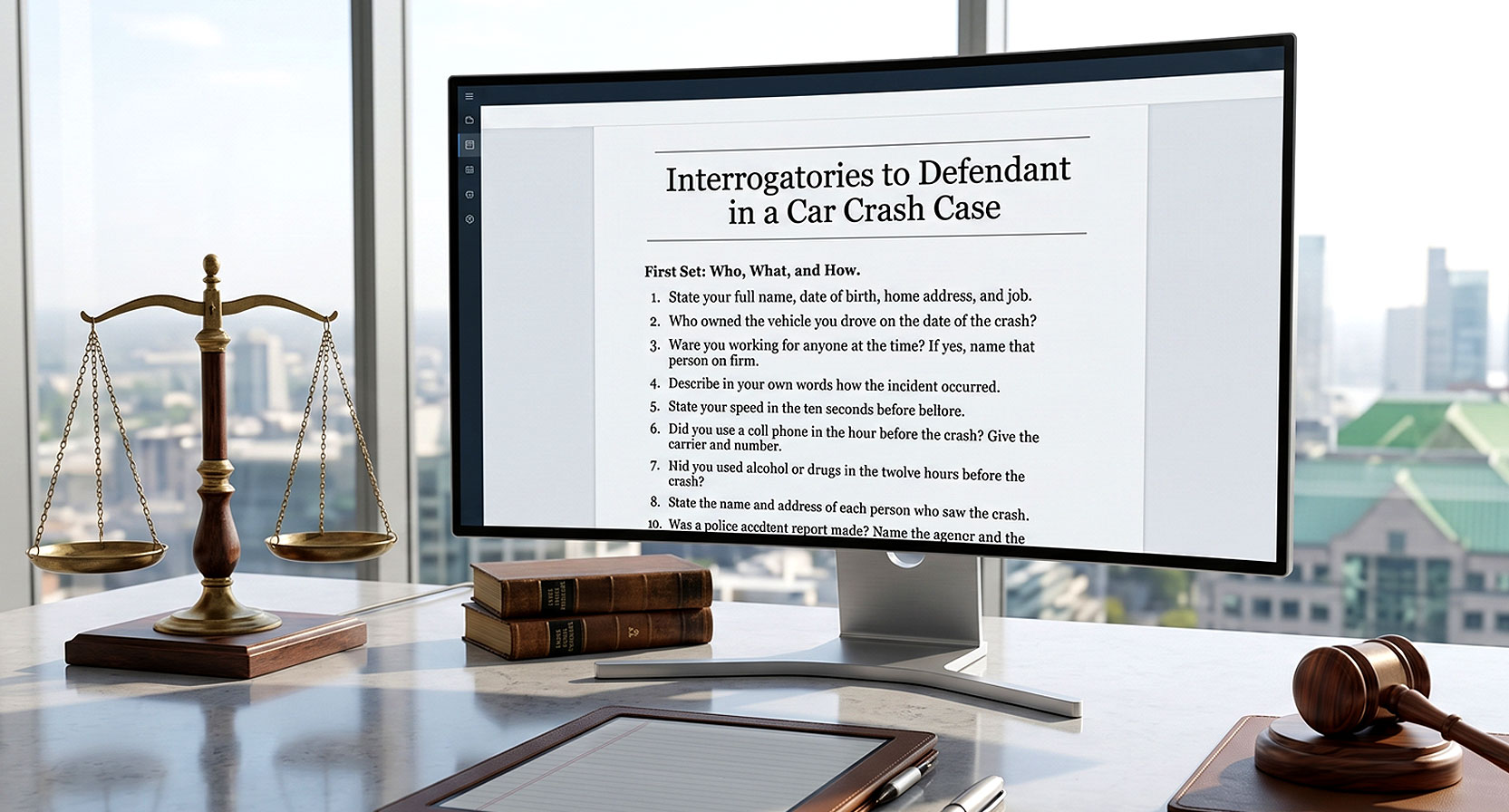
This is the core sample of car accident interrogatories. It is split into three sets. Serve the first set early. Use the later sets to fill gaps.
First Set: Who, What, and How
Use this plaintiff’s first set of interrogatories to the defendant to build the base facts.
- State your full name, date of birth, home address, and job.
- Who owned the vehicle you drove on the date of the crash?
- Were you working for anyone at the time? If yes, name that person or firm.
- Describe in your own words how the incident occurred.
- State your speed in the ten seconds before impact.
- Did you use a cell phone in the hour before the crash? Give the carrier and number.
- Had you used alcohol or drugs in the twelve hours before the crash?
- State the name and address of each person who saw the crash.
- Was a police accident report made? Name the agency and the report number.
- Do you have scene photographs or video of the crash site?
Second Set: Coverage, History, and Proof
- State all insurance coverage and policy limits that may apply to this claim.
- Name each liability insurance carrier and give each policy number.
- List every crash you have been in during the past ten years.
- Describe all recorded statements taken from any party or witness.
- Did anyone run surveillance on the plaintiff? Give the dates and the firm.
- Describe any repair, service, or inspection of the vehicle in the past year.
- State the amount of any claimed property damage and who paid for repairs.
- Identify every document you may use at trial.
Witness identity matters most here. So does insurance. Both are easy wins and hard to hide.
Third Set: Lock In the Defense
These are contention interrogatories. They force the other side to explain a position.
- If you deny fault, state every fact that supports that denial.
- If you claim comparative and contributory negligence, state each act you blame.
- State the facts that support each defense listed in your answer.
- State the facts that show the plaintiff failed in the mitigation of damages.
- Name each person in your expert witness disclosure. State each opinion.
- State each fact that shows the crash was not the proximate cause.
- If you deny the injury, state why.
Questions 1 through 8 are also good identification interrogatories. They just ask who and where.
Sample Interrogatories by Case Type
Each claim type needs its own questions. Below is a short list of example interrogatory questions for each one.
Slip and Fall and Premises Liability
Slip and fall cases turn on notice. Did the owner know about the hazard?
- When was the area last cleaned or checked before the fall?
- Who was on duty in that area that day?
- List every similar fall at this site in the past five years.
- Produce the written inspection policy in force that day.
Truck Accident: Questions to the Motor Carrier
Good truck accident interrogatories go after the paper trail.
- State how you screened and hired this driver.
- List all training the driver got in the past three years.
- State the driver’s hours of service for the seven days before the crash.
- Describe all electronic logging data for the truck.
- State when you told anyone to keep the crash records safe.
Truck Accident: Questions to the Driver
- State each stop you made on the trip.
- Describe your rest in the day before the crash.
- Were you paid by the mile or by the hour?
- Describe your pre-trip inspection.
Medical Malpractice
Medical malpractice interrogatories focus on the chart and the staff.
- Name each person who treated the patient on that date.
- State the written protocol that applied to this care.
- Describe how you were credentialed at this hospital.
- State what you told the patient about the risks.
Product Liability
Product liability interrogatories dig into design and testing.
- Describe each test done on this product before sale.
- List every complaint about this defect in the past ten years.
- Was this product ever recalled? Give the date and the reason.
- Name each person who signed off on the final design.
Dog Bite Cases
Dog bite interrogatories are short and blunt.
- Has this dog ever bitten a person or animal before?
- How was the dog kept or leashed that day?
- Who owns the dog and who cares for it?
- Has any animal control agency ever cited you?
Uninsured and Underinsured Motorist Claims
- State the uninsured/underinsured motorist limits on the policy.
- Name the adjuster who handled this claim.
- State each reason you deny the claim.
Wrongful Death
Wrongful death interrogatories cover both the death and the family loss.
- State the cause of death as you understand it.
- Name each person who saw the event.
- State each fact you use to dispute the family’s loss.
Rideshare Crashes
Rideshare accident interrogatories ask about app status.
- Was the driver logged into the app at the time?
- Was a ride in progress?
- State the coverage that applied at that moment.
Sample Interrogatories to Plaintiff: What the Defense Will Send
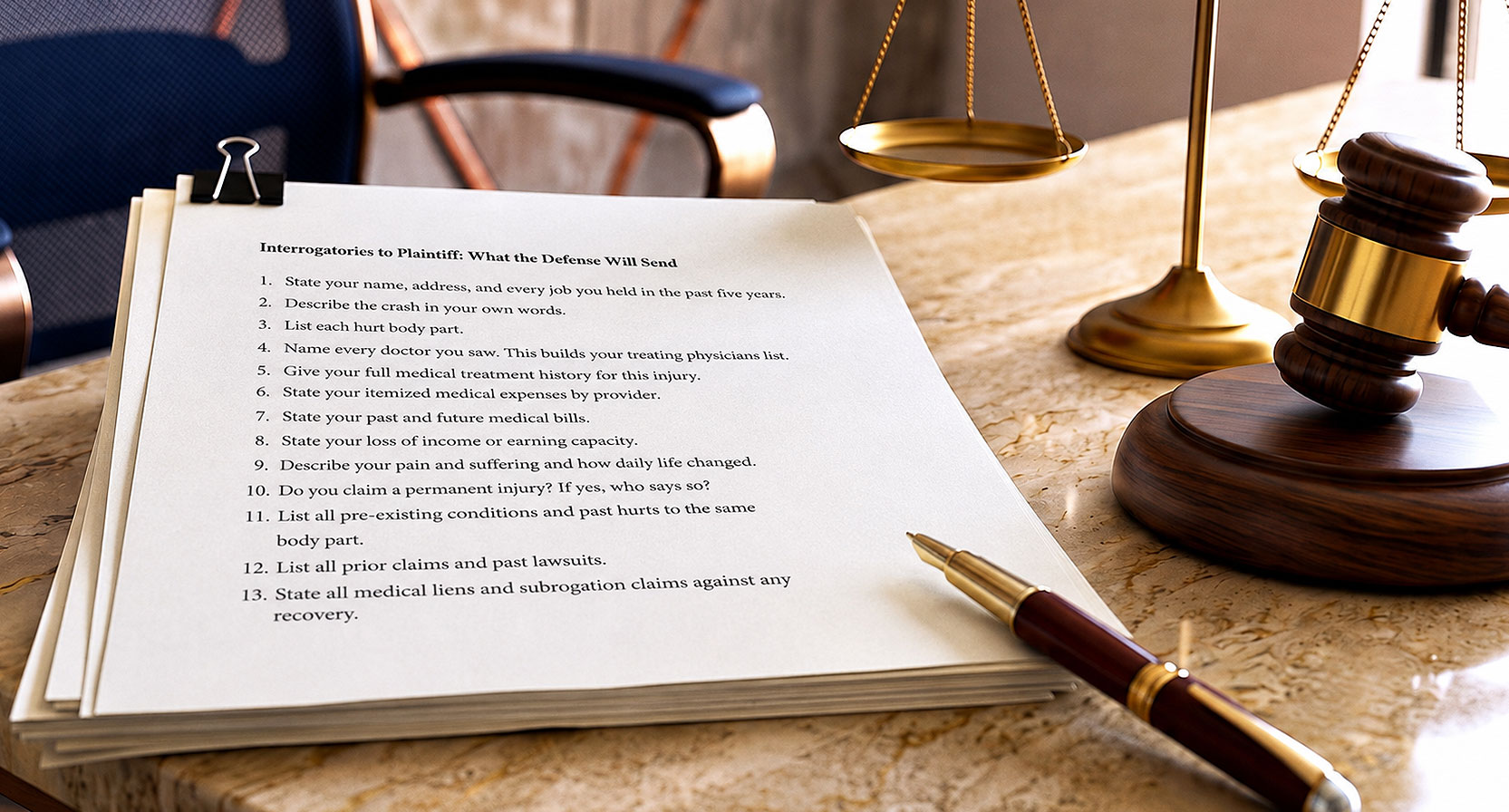
Now flip sides. A defendant’s interrogatories to the plaintiff are easy to predict. Defense firms and carriers reuse the same forms. They do it in almost every case. So a sample interrogatories-to-plaintiff list looks much the same each time.
Expect questions about your background and the crash. They also ask about your health and money losses. Here is a typical standard interrogatories personal injury set:
- State your name, address, and every job you held in the past five years.
- Describe the crash in your own words.
- List each hurt body part.
- Name every doctor you saw. This builds your treating physicians list.
- Give your full medical treatment history for this injury.
- State your itemized medical expenses by provider.
- State your past and future medical bills.
- State your loss of income or earning capacity.
- Describe your pain and suffering and how daily life changed.
- Do you claim a permanent injury? If yes, who says so?
- List all pre-existing conditions and past hurts to the same body part.
- List all prior claims and past lawsuits.
- State all medical liens and subrogation claims against any recovery.
This is also the classic sample interrogatories-to-defendant personal injury flow, in reverse. Both sides use the same shape.
Just got served? You likely have 30 days. Read the section on deadlines next.
How Many Interrogatories Can You Serve?
Limits change by court. Count before you send.
| Court | Limit | Note |
| Federal | 25 | Includes all discrete subparts |
| California | 35 special | Form sets do not count |
| Maryland | 30 | Includes subparts |
| Texas | 25 per party | Set by state rule |
| Florida | 30 | Set by state rule |
| New Jersey | Uniform forms | Plus a small number of extra questions |
In federal court, the Federal Rules of Civil Procedure control. Rule 33 interrogatories to parties sets the cap. A party may send no more than 25 written questions. Subparts count too. That 25-interrogatory limit is firm. You need a deal or a court order to go past it.
California is more open. State law allows 35 specially prepared questions. The rule sits in Code of Civil Procedure section 2030.030. Maryland allows 30 under Maryland Rule 2-421. Texas caps most cases at 25 under Rule 197 of the Texas Rules of Civil Procedure. Florida uses Florida Rule of Civil Procedure 1.340. New York discovery is governed by CPLR Article 31. Louisiana caps written questions at 35 under Article 1457 of its code.
How Subparts Are Counted
In most courts, a subpart counts as its own question. Five related parts can count as five questions. So a long, compound question does not save you space.
Getting Leave of Court
Need more? Ask. Courts may allow more when it fits the case’s needs. This ties to Rule 26 and its proportionality test. That same rule sets the scope of discovery. File a declaration for additional discovery when your state requests one. Judges often say yes when the case is complex. Get leave of court to serve additional interrogatories in writing.
Also plan the rest of your pretrial discovery around this cap. Some facts fit a request for production of documents better. That sits in Rule 34. Others meet the requirements for admission under Rule 36. A deposition by oral examination falls under Rule 30. Use a subpoena duces tecum for papers held by a non-party. Ask for an independent medical examination under Rule 35. Track every date against the scheduling order and the discovery cutoff deadline.
Form Interrogatories vs. Special Interrogatories
California gives you a free head start. The Judicial Council of California made a check-the-box form. It is called DISC-001.
DISC-001 covers identity, the event, and injuries. It also covers property damage, lost income, and insurance. It also asks about statements, witnesses, and past claims. The form was approved under Code of Civil Procedure section 2033.710. The current version took effect on January 1, 2024.
Why use it? The wording is pre-approved. That makes it much harder to attack as vague or too broad. The form also ties to California Rules of Court, rule 3.1000. Smaller cases use DISC-004 instead. File both in the Superior Court of California.
Two boxes matter most:
- Form Interrogatory 17.1 makes the other side back up every denied admission.
- Form Interrogatory 15.1 seeks the facts underlying each denial in the answer.
So the choice between form interrogatories and special interrogatories is simple. Start with the form. Then add custom questions for your facts. In California, the 35-special-interrogatories cap applies only to your custom interrogatories.
New Jersey uses uniform forms too. There, the complaint includes the forms. A defendant gets both at once.
Deadlines and Verification

In most states, you get 30 days to reply. Mail service can add a few days. That 30-day deadline to respond to interrogatories is the one to circle.
New Jersey runs on its own clock. A defendant there gets 60 days after answering the complaint.
Signing matters as much as the words. Answering interrogatories under oath is the rule. The party signs, not the lawyer. In California, unsigned replies can count as no reply at all. So never skip the verification page for interrogatories. Serve verified interrogatory responses every time.
Facts change. When they do, you must update. That is the duty to supplement discovery responses. Send supplemental responses to interrogatories as soon as you learn more. In Pennsylvania, updates are due within 30 days of learning the new facts.
One more note. Do not sit on a late reply. In many courts, you lose your right to object. That waiver of objections can be hard to undo.
Beating Common Objections
Expect pushback. Plan for it while you draft.
The Objections You Will See
Most objections to interrogatories come from a short list:
- Vague and ambiguous
- Overbroad and unduly burdensome
- Not reasonably calculated to lead to admissible evidence
- Calls for a legal conclusion
- Invasion of privacy
- Attorney-client privilege objection
- Work product objection
The last two often trigger a privilege log. That log lists what is held back and why. The work-product doctrine protects trial preparation. California puts it in Code of Civil Procedure section 2018.010. The attorney-client privilege protects legal advice.
Draft to Preempt Them
Boilerplate objections fail when you write with care. Courts want a real reason, not a list of stock words. So narrow your question first.
- Add a date range.
- Add a subject limit.
- Define your terms.
- Split long questions into two.
The goal is a code-compliant reply. Say the data pile is huge. Then point them to the business records option under Rule 33(d).
Meet and Confer, Then Move
Bad answers are common. Do not shrug. Send a discovery-deficiency letter listing each gap. Courts expect a real meet-and-confer try first. Do that before you go to the judge. Keep proof of that effort.
Still stuck? File a motion to compel further responses. Judges can order answers. They can add sanctions for failure to answer interrogatories under Rule 37. If a request goes too far, ask for a protective order.
The core idea is old and simple. Discovery exists to take the guesswork out of trial prep. That rule traces back to Greyhound Corp v. Superior Court.
Frequently Asked Questions
What are written questions in an injury case?
They are written interrogatories in a lawsuit. One side sends them. The other side must answer in writing and under oath. They are a key step in the discovery process in a personal injury lawsuit.
How many interrogatories can be served?
How many interrogatories you may send depends on the court. Federal courts allow 25. Maryland allows 30. California allows 35 custom ones.
How long do I have to answer?
Most states give 30 days. Ask for more time in writing if you need it.
Who signs the answers?
The party signs the answers under oath. A lawyer may sign the objections.
How do I answer them correctly?
Answering interrogatories in a personal injury case comes down to five steps. Read each one. Answer in plain words. Object only when you have a real reason. Review with your lawyer. Sign and serve on time.
What happens if you don’t answer?
What happens if you don’t answer interrogatories is not pretty. The other side can move to compel. A judge can order you to answer and add costs. In hard cases, a claim can be tossed out.
Can the answers be used at trial?
Yes. Sworn answers may be admitted as party admissions. See the Federal Rules of Evidence.
What is the difference between written questions and a deposition?
The difference between interrogatories and depositions is form. One is written. One is spoken and live. Written answers are drafted with a lawyer, so they are polished. Live answers are not.
What if someone lies?
Lying under oath is perjury. Courts can punish the party or toss the case.
Do form questions count toward the cap?
Not in California. Form sets sit outside the 35-question cap.
Where can I see a completed reply?
Look at a sample plaintiff’s answers to an interrogatories set. It shows how to answer and object at the same time.