
Car Accident Settlement Timeline in Texas
Getting hurt in a car crash is hard. Waiting for the money you need is even harder. If you are asking how long a car accident settlement takes, you are not alone. This guide walks you through the full car accident claim timeline, step by step, in plain words.
Quick Answer: Average Car Accident Settlement Time in Texas
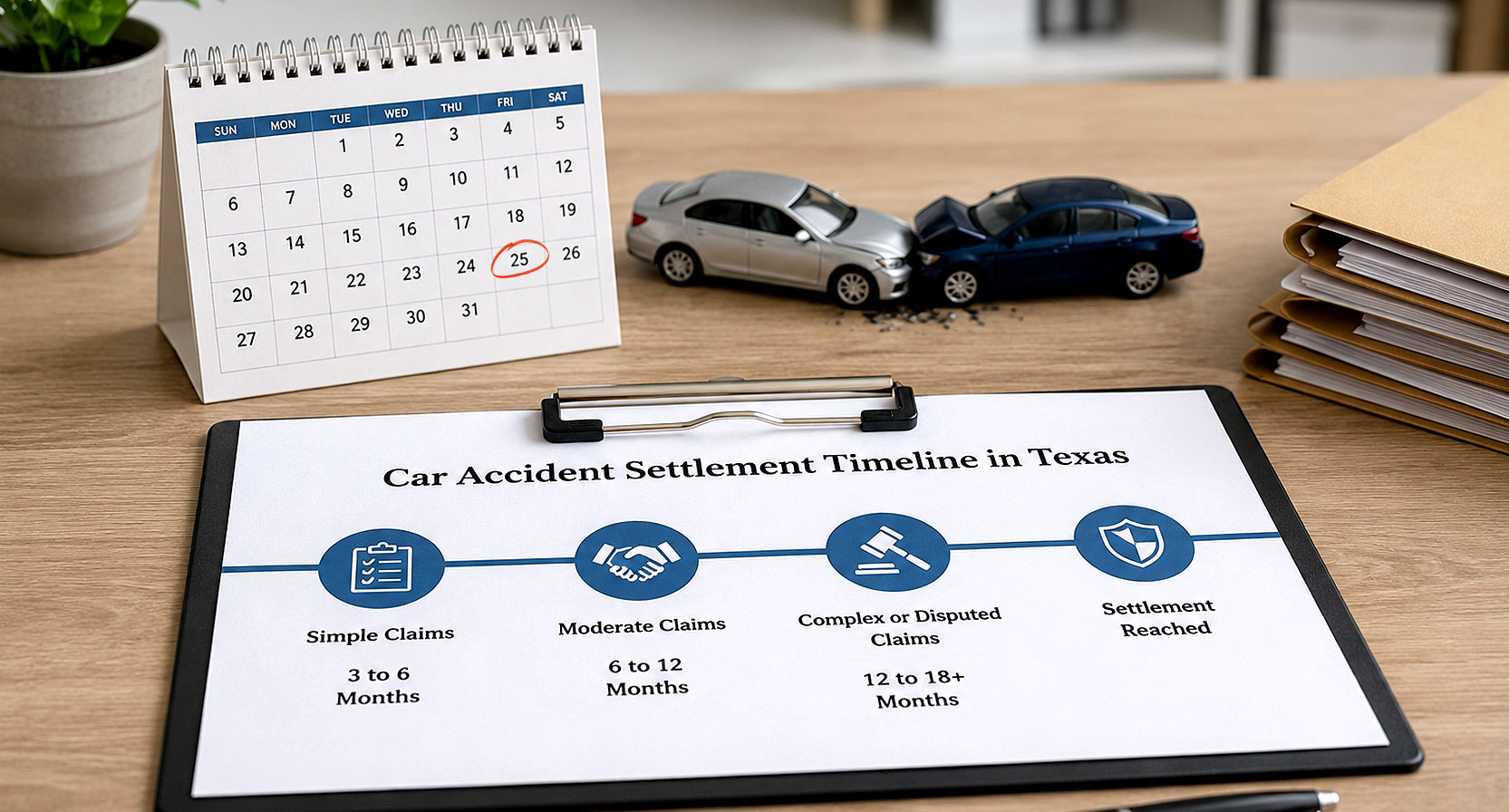
The average car accident settlement time for claims in Texas is between 3 and 18 months. Most land around 6 to 10 months. Your own car accident case timeline depends on your injuries, your evidence, and how the insurance company acts.
Here is a simple breakdown:
- Simple claims (clear fault, small injuries): 3 to 6 months
- Moderate claims (real injuries, some back and forth): 6 to 12 months
- Complex or disputed claims (lawsuit, serious injury, more than one driver at fault): 12 to 18+ months
Every case is different. But knowing the normal Texas car accident settlement process helps you know what is normal and what is a delay.
The Texas Car Accident Settlement Process, Step by Step

Step 1: Get Medical Care and Document the Scene
Right after a crash, your health comes first. Go get checked, even if you feel okay. Some injuries show up days later.
While you can, start gathering evidence that car accident teams need later:
- Take photos of the cars, the road, and any injuries.
- Get witness statements, names, and phone numbers.
- Obtain the police report of a car accident that officers create at the scene.
- Get a rough vehicle damage assessment and property damage estimate for your car.
This early work makes every later step move faster.
Step 2: File the Police Report
In Texas, officers must file a CR-3 crash report with the Texas Department of Transportation (TxDOT) within 10 days if someone was hurt, killed, or lost more than $1,000 in property. This rule comes from the Texas Transportation Code crash reporting law. If police never came to your crash, you may need to file the report yourself.
Step 3: Notify the Insurance Companies
Next comes filing an insurance claim. Notifying the insurance company after an accident, steps should happen fast, ideally within days.
Texas is an at-fault insurance state. This means the driver who caused the crash is responsible for the damage. Under the Texas fault-based system, you can file a third-party insurance claim against the other driver’s insurer, use your own first-party insurance claim, or both.
A few coverage terms matter here:
- Bodily injury liability coverage pays for injuries the at-fault driver caused you.
- Property damage liability coverage pays to fix or replace your car.
- Uninsured/underinsured motorist (UM/UIM) coverage protects you if the other driver has no insurance or not enough. Texas law sets minimum liability insurance requirements, but many drivers still carry too little. That is why uninsured motorist coverage Texas and underinsured motorist coverage Texas matter so much.
- Personal Injury Protection (PIP) and Medical Payments Coverage (MedPay) can help cover medical bills early, regardless of who caused the crash.
Under Texas Insurance Code claim deadlines, an insurance adjuster must act within the specified timeframes. This is the general insurance adjuster response time:
- The insurer must acknowledge your claim within about 15 business days.
- It then has more time, often around 45 days, to accept or deny the claim.
- Once it agrees to pay, Texas law requires payment within about five business days.
More complex claims, or a claim tied to fraud concerns, can take longer. This affects insurance claim processing time in Texas cases in different ways, so ask your adjuster for updates often.
Step 4: The Investigation Phase
This stage can run from a few weeks to a few months. It is the claim investigation period.
During an insurance adjuster’s investigation, the company checks the police report, your photos, your medical records, and the damage to both cars. The goal is liability determination, deciding who caused the crash and by how much.
This is also where fault investigation work often slows things down. If both drivers blame each other, the claim can sit for weeks while adjusters compare notes. In some cases, the Texas Department of Insurance may get involved if there is a dispute about how a claim was handled.
Step 5: Medical Treatment and Reaching MMI
Do not rush this part. Full medical treatment documentation protects your health and your claim.
Doctors use a term called maximum medical improvement (MMI). This means you have healed as much as you are going to, or your doctor has a clear, stable plan for your future care. Settling before you reach MMI is risky. You could end up paying for ongoing medical treatment out of your own pocket if new costs appear later.
Step 6: The Demand Letter
Once your health is stable, it’s time to begin the demand letter timeline. Your letter, or your lawyer’s letter, becomes part of a demand package. This package lists what happened, why the other driver is at fault, and what you are owed.
The insurance company can take 30 to 90 days to respond to a settlement offer request. This step often feels slow, but it is normal.
Step 7: Negotiation
Now comes the back and forth. This is the heart of the settlement negotiation timeline.
The first reply from the insurer is often a lowball offer, a number that is too low. Your job, or your lawyer’s job, is counteroffer negotiation. You explain why your claim is worth more and back it up with proof.
You are never forced into accepting a settlement offer you feel is unfair. Rejecting an insurance offer is a normal part of the process. Some claims settle in a few weeks. Others take several months of trading offers.
Step 8: Settlement Agreement or Lawsuit
If both sides agree on a number, you move on to signing the settlement agreement. This includes a release of claims, a legal document in which you agree to drop your claim in exchange for the payment. Once signed, it becomes a binding contract.
Before this step, the damages are sorted into two groups:
- Economic damages from a car accident costs are the ones you can add up with receipts, like medical expenses reimbursement, a lost wages claim, future medical care costs, diminished earning capacity, and property damage compensation.
- Non-economic damages are harder to price. This includes pain and suffering compensation for the hurt the crash caused you.
In rare cases, courts may allow punitive damages, as Texas law permits, meant to punish very reckless behavior. Calculating settlement value takes all of these factors into account to arrive at a fair settlement amount, since there is no single formula for a car accident settlement.
If the two sides cannot agree, the case may become a Civil Lawsuit. This starts the litigation timeline Texas courts follow. It includes:
- Discovery Process work, in which both sides exchange evidence. This is the discovery phase timeline and the pretrial discovery process stage. It often includes a deposition process in which people answer questions under oath.
- Mediation, a required step in many Texas courts before a case can go to trial. This is part of the broader mediation timeline and falls under Alternative Dispute Resolution (ADR).
- A possible Trial Setting, if mediation fails.
Filing a Personal Injury Claim as a lawsuit does not mean you are stuck going to trial. Most cases still settle, even during litigation. This is the choice between settlement vs trial, and most people and most insurers prefer to avoid a courtroom when they can.
Step 9: Getting Your Settlement Check
After you sign, the final settlement payment usually arrives in about 4 to 6 weeks. This is the normal settlement check disbursement time. Delays can occur if there are unpaid bills associated with your case. This is called a medical lien settlement, where doctors or hospitals must be paid from your check before you get the rest.
What Slows Down a Car Accident Settlement in Texas?
Some things are simply outside your control. Common causes of delay include:
- Severity of injuries. More severe injuries require more treatment time, which delays the overall process.
- Disputed liability. When both sides argue over who caused the crash, talks can stall for weeks.
- Multiple parties are involved in accident cases in which more than one driver, company, or insurer shares blame.
- A commercial truck accident claim, which often involves large companies and their own legal teams.
- A government entity accident claim, which comes with strict notice rules and short deadlines, sometimes just 90 days.
- Insurance company delay tactics, such as slow replies or requests for more paperwork than needed.
- Medical records delays, when clinics take weeks to send paperwork.
- A complex personal injury case or a catastrophic injury claim, both of which need more proof, more experts, and more time.
Local courts matter too. Harris County Courts, Travis County Civil Courts, and Dallas County Courts all handle high volumes of cases, and their schedules can shape how fast your case moves if it goes to trial.
What Can Speed Up Your Settlement?

You have more control than you might think. These steps can help:
- See a doctor right away, and keep every appointment. Gaps in treatment give the insurance company a reason to doubt your injury.
- Keep clear, complete records. Save every bill, receipt, and note about work you missed.
- Report the crash and file your claim fast. The sooner your claim starts, the sooner the clock moves.
- Hire an attorney early. A skilled Texas-based personal injury attorney can push your claim forward, handle paperwork fast, and spot lowball offers before you accept one.
- Ask about a contingency fee. Most attorneys work this way, so you pay nothing unless you win.
- Let your attorney negotiate for you. A clear, firm negotiation strategy often gets better offers faster than going it alone.
- Respond quickly to any request from the insurance company. Slow replies on your end can stall the whole process.
One more tip: avoid posting about the crash or your injuries on social media. Insurance companies do check, and a single photo or comment can be used to question your claim.
Texas Car Accident Settlement Timeline: Statute of Limitations
Texas law gives you a firm deadline. The Texas statute of limitations car accident rule, found in the Texas Civil Practice and Remedies Code, section 16.003, gives you two years from the crash date to file. This is your personal injury claim deadline.
Miss it, and you likely lose your right to sue for good. A few exceptions exist, such as cases involving children or government defendants, so talk to a lawyer early if you think your case might be different.
Courts also track their own busyness. The Texas Judicial Branch’s court statistics reports show how caseloads and wait times change across the state each year. These numbers help explain why some counties move faster than others.
How Texas’s Fault Laws Affect Your Settlement Timeline
Texas follows modified comparative negligence. This is often called the Texas comparative fault rule.
Here is how it works in plain terms. If you shared some blame for the crash, your payment is reduced by your share of the fault. But there is a limit. Under the 51% bar rule Texas law sets, also known as the Modified Comparative Fault Rule (§ 33.001) or simply the 51% Bar Rule, you cannot collect anything if you were more than half at fault.
This rule is a common source of delay. When an insurer tries to pin more blame on you, it slows down every step.
Should You Settle Before Finishing Treatment?
It is tempting to take a quick check, especially with bills piling up. But settling before you know the full cost of your injury is a real risk. Once you sign a release, you cannot go back and ask for more, even if new symptoms appear next month.
Waiting until you reach MMI, or until your doctor has a solid long-term plan, gives you a truer picture of what your claim is worth.
Do You Need a Lawyer to Settle Faster (and Fairer)?
You are not required to hire a lawyer. Many small, clear-fault claims settle fine without one.
But once injuries get serious or fault is disputed, a lawyer often changes the outcome. A good attorney knows how to handle filing a lawsuit after accident talks stall, how to push past insurance company delay tactics, and how to value both economic and non-economic losses.
Car Accident Settlement Timeline FAQs
How long does it take to get a settlement check after signing in Texas?
Usually about 4 to 6 weeks. This can shift if there are unpaid medical liens to settle first.
What is the average car accident settlement amount in Texas?
There is no set number. It depends on your injuries, your bills, your lost wages, and the strength of your evidence.
Can I speed up my car accident settlement?
Yes. Fast medical care, full documentation, and early legal help all shorten the process.
What happens if the insurance company denies my claim?
This is called a car accident claim denial. You can request a written reason, gather more proof, and start an insurance claim appeal. A lawyer can help push back against an unfair denial.
Do all car accident claims in Texas end up in court?
No. Most claims settle through simple negotiation with the Insurance Company and never reach a courtroom.
How long do I have to file a car accident claim in Texas?
Two years from the date of the crash, under Texas law, with rare exceptions.
What if the at-fault driver has no insurance?
Your own UM/UIM coverage can step in. You may also be able to sue the At-Fault Driver directly if they have money or property to collect from.
Is it better to settle or go to trial?
Most people prefer to settle. Trials take more time and carry greater risk, but they can yield a larger payout in strong cases.