
Motion to Dismiss Template for Personal Injury Cases
Getting sued after an accident is stressful. But not every lawsuit has to go to trial. A motion to dismiss asks the judge to end a case, or part of it, early.
This guide explains how a motion to dismiss template for personal injury cases works. You will learn the main reasons to file one and what goes in each part. You will also learn what happens after you file. A sample template is near the end.
What Is a 12(b)(6) Motion in Simple Terms?
Most federal motions to dismiss use Rule 12(b)(6). In plain words, this motion says the plaintiff cannot win even if every fact in the complaint is true. It argues that the facts, even if accepted, do not support a claim the law will recognize.
At this stage, the judge does not weigh proof. The judge reads the complaint in the plaintiff’s light. The judge also draws reasonable inferences in the plaintiff’s favor. An inference is a logical guess based on the facts.
This rule has been around a long time. In one New Hampshire case, a federal judge relied on Scheuer v. Rhodes (1974). The court said it had to read the complaint in the plaintiff’s favor and treat its key facts as true.
But judges do not accept everything. They set aside empty labels and guesses. Courts often cite Gregory v. Shelby County (6th Cir. 2000) on this point. Under that case, a court need not accept legal conclusions or unwarranted factual inferences as true.
Federal courts also use a “plausibility” test from two Supreme Court cases, Twombly and Iqbal. A complaint needs enough facts to make the claim believable, not just possible. A bare label like “the defendant acted negligently” gets no weight on its own.
Many of these terms have exact legal meanings. Lawyers often check Black’s Law Dictionary. For example, it describes a prima facie case as enough evidence to let the fact finder rule for that party.
Can a Personal Injury Case Be Dismissed?
Yes. A judge can dismiss a case when the complaint has a serious flaw.
For example, a car crash plaintiff must plead every part of a negligence claim. If the complaint omits one of those parts, the defendant can move to dismiss.
A case can also be dismissed if it was filed too late. For example, if a negligence suit was filed five years after an injury, when the deadline was two years. The defendant could ask the court to dismiss the entire case.
You do not have to attack the whole complaint. A defendant can target the entire complaint or just certain claims, and can raise more than one reason.
Early motions also support judicial efficiency. That saves the court time and money. They can end weak cases quickly and protect defendants from meritless claims.
A motion can stop a frivolous lawsuit before it grows. A frivolous lawsuit has no real legal or factual basis. Winning early leads to early case resolution, which saves both sides money.
When Is a Motion to Dismiss Due?
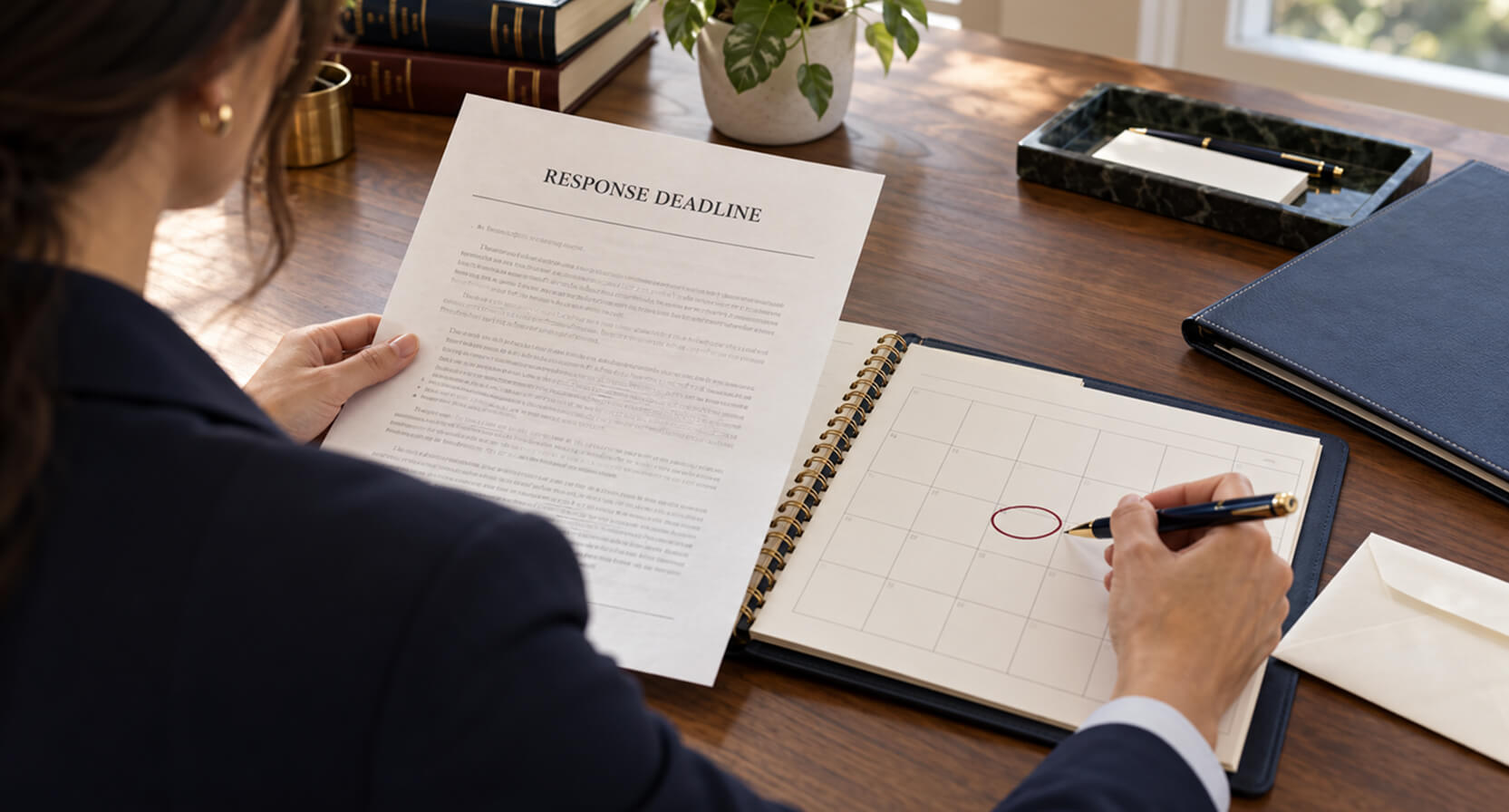
Timing matters a lot. Under Rule 12(a)(1)(A)(i) of the Federal Rules of Civil Procedure, a defendant usually has 21 days after being served to respond. A Rule 12(b) motion takes the place of the answer and is due in that same window. State deadlines vary, so check the summons and local rules.
Filing on time is the key to avoiding default judgment. A default judgment can happen when a defendant does not respond at all. A timely motion to dismiss counts as a response.
Need more time? You can ask the court for an extension of time to respond to complaint papers. Lawyers often agree to a stipulated extension to answer. This is a written agreement between both sides. Some courts still need to approve it.
Sometimes a case filed in state court can move to federal court. 28 U.S.C. § 1441 lets a defendant remove certain cases. For cases based on the parties being from different states, the amount-in-controversy requirement must be met. The claim must be worth more than $75,000. One exception: a railroad injury case under FELA that was filed in state court usually cannot be removed.
Motion to Dismiss vs. Filing an Answer
An answer responds to each claim in the complaint. The defendant admits or denies each fact. It also lists defenses.
A motion to dismiss is different. It says the complaint should not move forward at all.
What if you lose the motion? If the court denies it, the case goes on, and the defendant must file an answer. A new deadline for the answer starts.
Motion to Dismiss vs. Motion for Summary Judgment
A motion to dismiss looks only at the complaint. A summary judgment motion looks at evidence.
Under Rule 56, a court grants summary judgment when no genuine dispute of material fact exists. One side must also be entitled to win as a matter of law. This motion usually comes later, after both sides trade evidence.
Be careful with matters outside the pleadings. These include photos, emails, and sworn statements. If you attach them to a motion to dismiss, the judge may treat it as a summary judgment motion instead.
There is an exception for documents incorporated by reference. These are papers the complaint itself relies on, like an insurance policy. Courts can often read them without changing the motion type.
Common Grounds for a Personal Injury Motion to Dismiss
Federal law lists seven grounds, including lack of jurisdiction, improper venue, problems with process or service, failure to state a claim, and failure to join a required party. Here is how some apply in injury cases.
Problems With Papers and Service
Rule 12(b)(4) covers insufficient process. This means the summons itself has an error, like the wrong name or court. Rule 12(b)(5) covers bad delivery of the papers. In many state courts, you fight bad service with a motion to quash service.
A misnomer occurs when the plaintiff uses the wrong name for the right person or company. Courts usually let the plaintiff fix it. But sometimes the plaintiff sues the wrong party entirely. If an improperly named defendant has nothing to do with the accident, the court can dismiss the claim against it.
Missing Parties
Rule 12(b)(7) allows dismissal for failure to join a party under Rule 19. Rule 19 says some parties must be in the case for fairness. Courts rarely dismiss on this ground. They usually add the missing party instead.
Unclear or Improper Claims
Rule 12(e) lets you ask for a clearer complaint. You use it when the complaint is too vague to answer.
Rule 12(f) lets a court strike parts of a pleading. It covers parts that are repeated, off topic, or scandalous.
A sham pleading is one the filer knows is false. Some courts will strike sham pleadings.
Put All Your Defenses in One Motion
cc is a big deal. If you file a Rule 12 motion, you usually cannot file a second one raising a defense you left out. So file one consolidated Rule 12 motion. You lose defenses based on personal jurisdiction, venue, process, and service if you leave them out of your first motion or answer.
Named Workers and Unknown People
Plaintiffs often sue a company and one of its workers, like a store manager. A motion to dismiss individual employee defendant claims argues that the complaint shows nothing that person did wrong. Sometimes a local worker is named just to keep the case in state court.
Plaintiffs also sue “John Doe” when they do not know who caused the harm. A motion to dismiss John Doe defendants may argue they were never named or served in time. In one New Hampshire federal case, the court had to decide whether it properly served a John Doe defendant.
Personal Jurisdiction: Is This the Right Court?
A court must have power over the defendant. Three Supreme Court cases guide this issue.
In Goodyear Dunlop Tires Operations v. Brown (2011), two North Carolina boys died in a bus crash in France. Their families sued foreign tire makers in North Carolina. The Court said those companies were not “at home” in that state. So the state court could not hear every claim against them.
In Walden v. Fiore (2014), the Court examined the defendant’s contacts with the state. The plaintiff’s ties to the state were not enough.
In Sinochem International Co. v. Malaysia International Shipping Corp. (2007), the Court said a federal court can rule on forum non conveniens even before deciding whether it has jurisdiction. Forum non conveniens means another court is a much better place for the case.
Time Limits: Statutes of Limitations and Repose

Every state sets a deadline to sue. A few examples:
- New York CPLR 214 gives three years for most injury claims.
- Texas Civil Practice and Remedies Code § 16.003 gives two years.
- Georgia O.C.G.A. § 9-3-33 gives two years.
- In Louisiana, this deadline is called prescription. The state’s rules call it a “prescriptive period.”
A court will only dismiss a case as late when the complaint makes that clear. A Massachusetts federal court explained that dismissal on timing grounds is proper when the complaint leaves no doubt that the claim is late.
A statute of repose is a harder limit. It runs from a fixed event, like the date a product was sold. It can block a claim even before the injury shows up.
Some rules pause the clock. Equitable tolling may pause it when fairness requires. For example, if the plaintiff was misled. Tolling for minors pauses the clock in many states until a child turns 18.
Immunity Defenses
Immunity means the law protects certain defendants from being sued, or limits what they owe.
Cities, Counties, and States
A motion to dismiss a claim against city or county officials often starts with notice rules. Many states require notice before a suit. Oregon, for example, generally requires notice of a claim within 180 days.
Immunity laws also apply. In one Tennessee case, an officer filed a motion under Tennessee Rule of Civil Procedure 12.02(6). He argued he was immune under the Tennessee Governmental Tort Liability Act and that the city was the right party.
The public duty doctrine is another defense. It says the government owes a duty to the public as a whole, not to one person. There is an exception when a special relationship exists.
Federal Employees
A motion to dismiss a claim against federal employee defendants often uses the Westfall Act (28 U.S.C. § 2679(d)). The government can certify that the worker acted within the scope of employment. Then the United States takes the worker’s place in the case. This is called Westfall Act substitution.
The discretionary function exception may then apply. It protects the government from claims based on policy choices. Choosing which roads to repair first is one example.
Charities and Hospitals
Some states give charitable immunity to nonprofits. The New Jersey Charitable Immunity Act can block or limit negligence claims against some nonprofit groups. For nonprofit hospitals, it caps damages instead of blocking claims.
A motion to dismiss hospital negligence claims may also point to state rules for medical cases. Many states require an expert statement before the case can proceed.
Other Defenses You Can Raise Early
Some defenses depend on facts, so they often win later. But if the complaint itself proves the defense, you can raise it now.
- Assumption of risk: The plaintiff knew about a clear danger and chose to face it anyway.
- Open and obvious doctrine: The danger was easy to see, like a big hole in plain view.
- Economic loss rule: You usually cannot sue in negligence for money loss alone, with no injury to a person or other property.
- No-fault serious injury threshold: In some no-fault car insurance states, you must show a “serious injury” to sue for pain and suffering. Defendants often raise this later with medical proof.
Partial Motion to Dismiss: Attacking Specific Counts
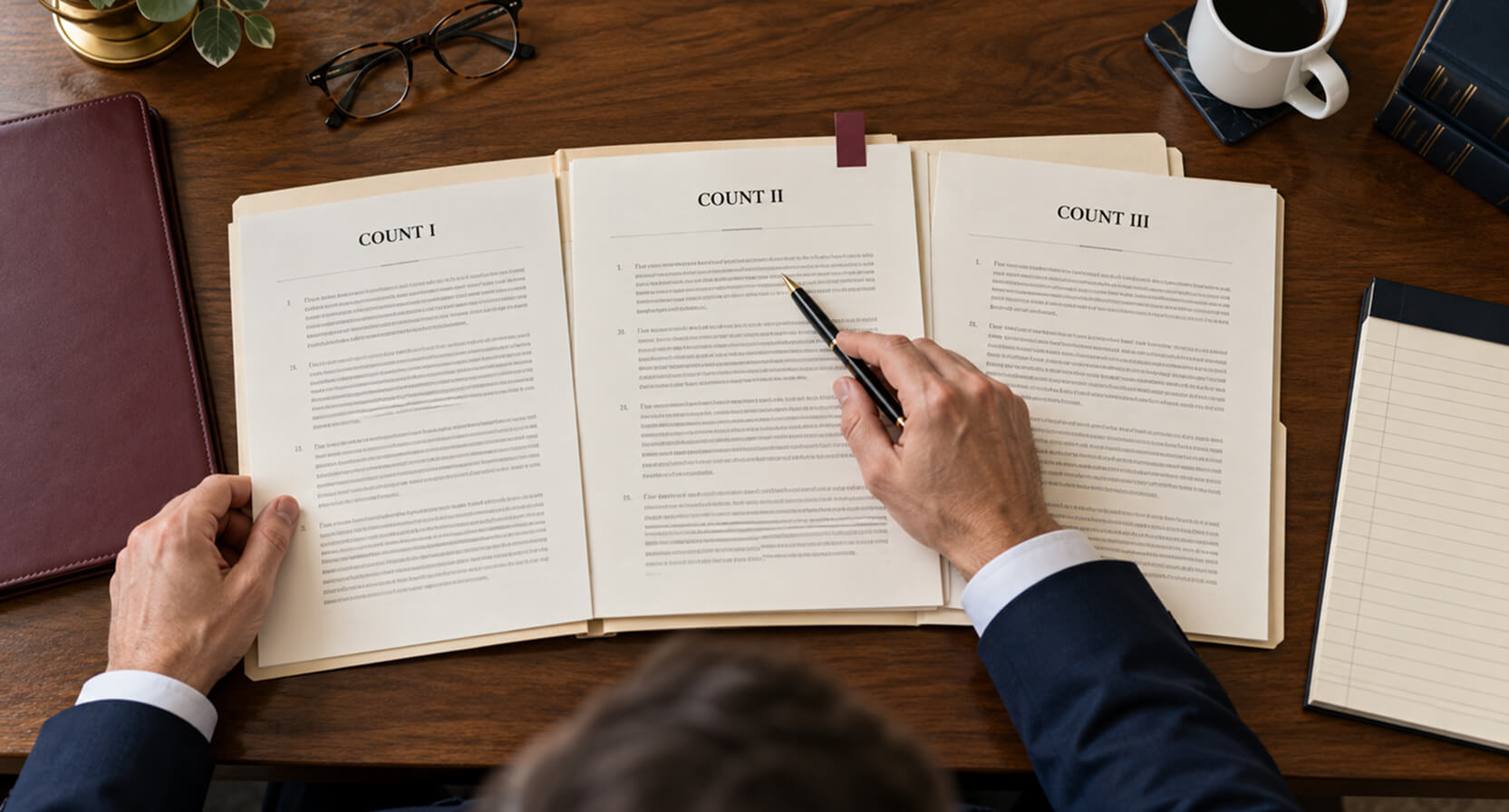
A partial motion to dismiss targets only some claims. Dismissing specific counts can shrink a case and lower the stakes.
Punitive Damages and Gross Negligence
A motion to dismiss punitive damages claims is common in car crash cases. In one New Jersey federal case, the plaintiffs claimed negligence and gross negligence after a turnpike crash. The court granted the defendants’ motion to dismiss the punitive damages claim. The author notes that, unless the facts are egregious, this kind of motion usually succeeds in a simple negligence case.
A motion to dismiss a gross negligence count works similarly. Gross negligence means extreme carelessness. The complaint needs facts showing more than a simple mistake.
Also check Rule 9(g). It says special damages must be stated clearly. Special damages are specific money losses, like certain lost earnings.
Emotional Distress Claims
A motion to dismiss negligent infliction of emotional distress claims is often worth filing. In one case, a trial court granted a motion to dismiss a negligent infliction claim, and the appeals court agreed.
A bystander emotional distress claim comes from someone who saw a loved one get hurt. Dillon v. Legg (1968) let a mother sue after seeing her child struck by a car. Later, Thing v. La Chusa (1989) set strict rules. The plaintiff must be a close relative and must be present when it happens. The plaintiff must also know the loved one is being hurt.
Some states use the zone-of-danger rule instead. The plaintiff must also have been in physical danger.
In Molien v. Kaiser Foundation Hospitals (1980), the California Supreme Court let a husband sue as a “direct victim.” Doctors had wrongly told his wife she had a serious disease.
Elden v. Sheldon (1988) went the other way. A man was injured in a crash that killed his unmarried partner. He sued for emotional distress and loss of consortium. The trial court sustained the defendants’ challenge to those claims without leave to amend, and the California Supreme Court agreed they could not proceed. “Without leave to amend” means no second try.
A motion to dismiss intentional infliction of emotional distress claims has a different focus. This claim needs extreme and outrageous conduct. Ordinary carelessness is not enough.
Claims Against Employers and Owners
A motion to dismiss a respondeat superior claim may argue the worker was off duty. It may also argue the worker was a contractor, not an employee. Respondeat superior makes an employer pay for an employee’s on-the-job acts.
A motion to dismiss negligent hiring and supervision claims may argue the complaint shows no warning signs. The plaintiff must show the employer knew, or should have known, the worker was a danger. In some states, this claim is redundant if the employer admits the worker was employed.
A motion to dismiss negligent entrustment claims targets a vehicle owner who lent a car or truck to someone else. The complaint must show the owner knew the driver was unsafe.
Duty and Cause
Every negligence claim needs a duty and a cause. Palsgraf v. Long Island Railroad Co. (1928) is the classic case on this. A woman was hurt by an accident at the far end of a train platform. The court said the railroad owed her no duty, because her harm was not foreseeable.
Today, many courts also look to the Restatement (Third) of Torts: Liability for Physical and Emotional Harm. It explains how duty, causation, and emotional-harm rules work.
Motion to Dismiss by Type of Accident
Every type of case has its own common weak spots.
Motion to dismiss truck accident lawsuit: Trucking cases often name the driver, the trucking company, and a broker. A broker may argue the complaint shows no link to the crash.
Motion to dismiss motorcycle accident claim: These often turn on whether the complaint pleads each part of negligence. Vague claims about “unsafe driving” may not be enough.
Motion to dismiss pedestrian injury lawsuit: If the plaintiff blames road design, the city may raise immunity or notice rules.
Motion to dismiss construction site injury claim: Workers’ comp laws often protect the direct employer. In one Illinois case, a court granted a general contractor’s motion to dismiss, finding it immune under the workers’ comp law’s exclusive remedy rules.
Motion to dismiss nursing home negligence complaint: Some states require notice or an expert’s statement before suit. Many nursing home contracts also include arbitration terms.
Motion to dismiss civil assault and battery claim: These are intentional wrongs. Some states give a shorter filing deadline. An employer may also argue the worker’s act was outside the job.
Motion to dismiss uninsured motorist claim: Here the plaintiff sues their own insurance company. The insurer may argue the plaintiff did not follow the policy’s rules, like giving notice or using arbitration.
Motion to dismiss rideshare accident lawsuit: The app company may argue the driver is not its employee. Rider terms may also require arbitration.
Motion to dismiss toxic exposure claim: These often turn on timing. The complaint must also link a specific substance to a specific injury.
Motion to dismiss FELA railroad injury claim: The Federal Employers’ Liability Act (FELA) lets injured railroad workers sue their employer. FELA has a three-year deadline.
Motion to dismiss maritime injury claim: The Jones Act lets injured seamen sue their employers. If the worker was not a “seaman,” a Jones Act claim may be dismissed.
State Rules and Different Names
State courts use their own rules. Some even use different names for a motion to dismiss.
| State | Rule | What It Is Called |
| Pennsylvania | Pennsylvania Rule 1028 | Preliminary objections |
| New Jersey | New Jersey Rule 4:6-2(e) | Motion to dismiss for failure to state a claim |
| Michigan | Michigan MCR 2.116(C)(7) and (C)(8) | Summary disposition |
| Georgia | Georgia O.C.G.A. § 9-11-12(b)(6) | Motion to dismiss |
| Ohio | Ohio Civil Rule 12(B)(6) | Motion to dismiss |
| Virginia | Virginia Code § 8.01-273 | Demurrer |
| Louisiana | Louisiana Code of Civil Procedure art. 927 | Peremptory exception |
| Tennessee | Tennessee Rule 12.02(6) | Motion to dismiss |
Texas has two special tools. A plea to the jurisdiction is often used when a government defendant claims immunity. A special appearance challenges personal jurisdiction. In Texas, you must file a special appearance before almost anything else. If you don’t, you may lose the objection.
How to Write the Motion: Parts of the Template

A good customizable legal template follows a clear order. Here are the main parts.
The Caption and Opening
Rule 10(a) says every filing needs a caption. It lists the court, the parties, the case number, and the title.
Rule 7(b) says a motion must be in writing. It must state the reasons and the relief you want.
Many motions open with “comes now the defendant” or say the defendant “respectfully moves this court” to dismiss. One sample begins with “NOW COMES Defendant” and asks the court to dismiss the complaint under Rules 12(b)(1) and 12(b)(6).
The Body
Most motions include these sections:
- Introduction and summary of argument: A short overview of why the case should end.
- Statement of issues presented: The legal questions the judge must answer.
- Procedural history section: When the complaint was filed and served.
- Facts: A summary of the plaintiff’s own claims, with paragraph numbers.
- Legal standard: The test the court uses.
- Argument: Your reasons, each under its own heading.
Some courts want a separate brief in support of a motion to dismiss. In one federal motion, the defendants asked the court to dismiss for the reasons in the motion and in an attached supporting brief. Other courts want an incorporated memorandum of law. That means the legal argument goes inside the motion itself.
Citations and Format
Use Bluebook legal citations unless your court says otherwise. The Bluebook is the standard guide for citing cases and laws.
Some courts require pleading paper formatting. California, for example, uses paper with line numbers down the left side. Other courts limit length and require a word count certification at the end.
The Ending
The motion ends with a “wherefore” clause. It asks the court to grant the motion for the stated reasons.
Next comes the signature. Under Rule 11(b), signing means you checked that your claims have a legal and factual basis.
Last is the certificate of service. It confirms the date and way you sent a copy to the other side.
Picking the Right Template
You have several choices:
- A fill-in-the-blank motion template is fast but basic.
- An attorney-drafted template is often more reliable.
- An editable DOCX pleading lets you change the format to fit your court.
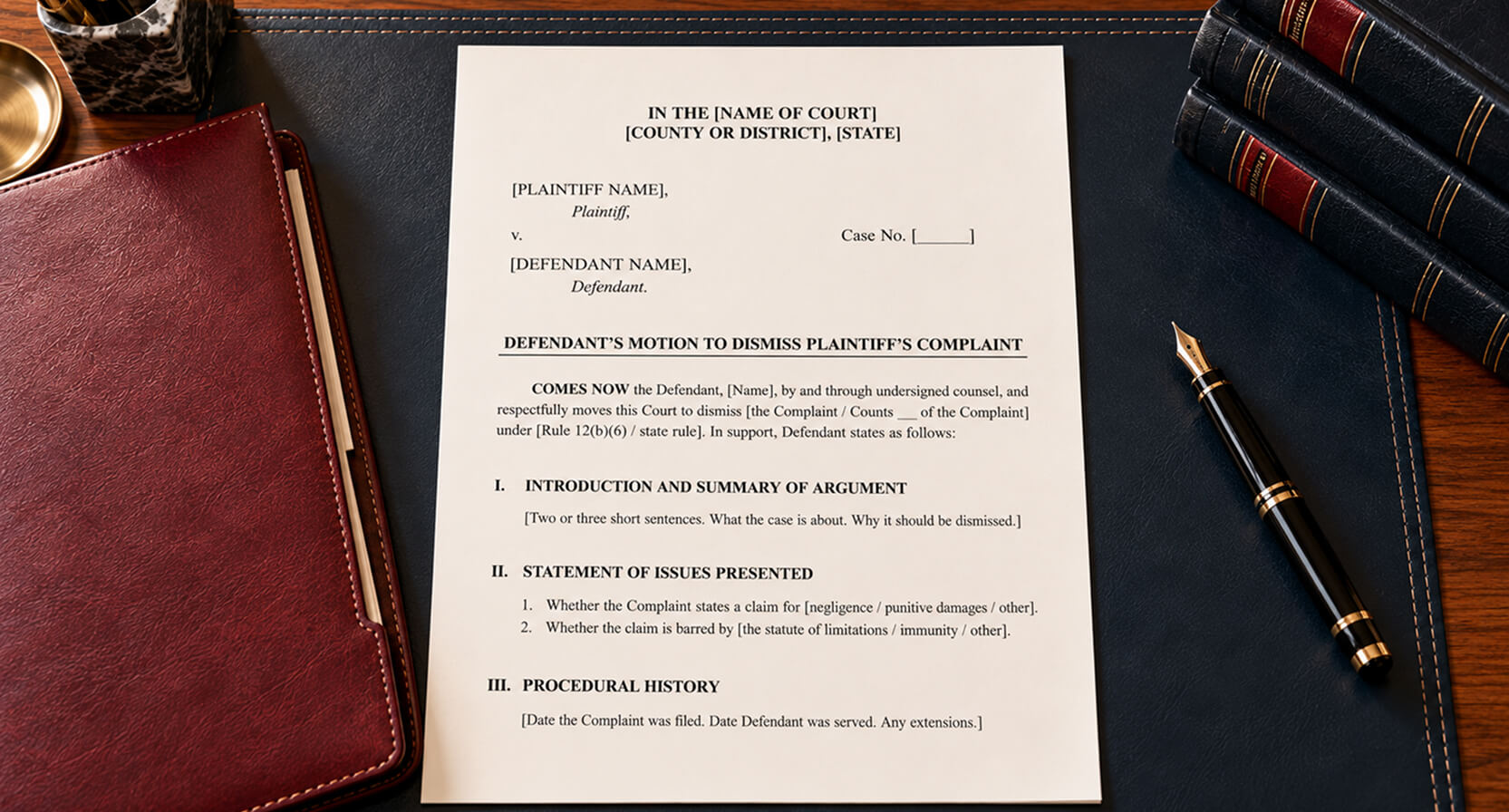
Sample Motion to Dismiss Template for Personal Injury Cases
Use this as a starting point only. Change it to fit your court’s rules.
IN THE [NAME OF COURT]
[COUNTY OR DISTRICT], [STATE]
[PLAINTIFF NAME], Case No. [_____]
Plaintiff,
v.
[DEFENDANT NAME],
Defendant.
DEFENDANT’S MOTION TO DISMISS PLAINTIFF’S COMPLAINT
COMES NOW the Defendant, [Name], by and through undersigned
counsel, and respectfully moves this Court to dismiss [the
Complaint / Counts ___ of the Complaint] under [Rule 12(b)(6) /
state rule]. In support, Defendant states as follows:
I. INTRODUCTION AND SUMMARY OF ARGUMENT
[Two or three short sentences. What the case is about. Why it
should be dismissed.]
II. STATEMENT OF ISSUES PRESENTED
1. Whether the Complaint states a claim for [negligence /
punitive damages / other].
2. Whether the claim is barred by [the statute of limitations /
immunity / other].
III. PROCEDURAL HISTORY
[Date the Complaint was filed. Date Defendant was served. Any
extensions.]
IV. FACTS ALLEGED IN THE COMPLAINT
[Summarize the plaintiff’s own claims. Cite paragraph numbers.
Do not add new facts.]
V. LEGAL STANDARD
[State the test for dismissal in your court. Cite the main cases.]
VI. ARGUMENT
A. [First reason. Example: The claim was filed too late.]
B. [Second reason. Example: The Complaint alleges no facts that
support punitive damages.]
C. [Third reason, if any.]
VII. CONCLUSION
WHEREFORE, Defendant respectfully requests that the Court grant
this Motion, dismiss [the Complaint / Counts ___] [with/without]
prejudice, and grant any other relief the Court finds just.
Dated: [_____] Respectfully submitted,
[Attorney Name, Bar No.]
[Firm, Address, Phone, Email]
Attorney for Defendant
CERTIFICATE OF SERVICE
I certify that on [date], I served a copy of this Motion on
[name] by [method] at [address or email].
[Signature]
What Happens After a Motion to Dismiss Is Filed?
First, the plaintiff files a written response. Then the defendant may file a reply.
Next, the court sets a date. Look for a motion calendar and hearing notice from the clerk. Some courts, like many in California, post a tentative ruling the day before the hearing. It shows how the judge plans to rule.
The judge can grant the motion, deny it, or grant it in part. If the case ends, the court enters a judgment of dismissal.
Judges often let plaintiffs fix their complaint. But a judge may refuse because an amendment would be futile. That means no new facts could save the claim.
How Long Does a Judge Take to Rule on a Motion to Dismiss?
There is no set time. It often takes weeks or months. Busy courts can take longer. Federal courts must publicly report motions that have been waiting more than six months.
Can You Refile After a Motion to Dismiss Is Granted?
It depends on the type of dismissal. A dismissal with prejudice ends the case for good. A dismissal without prejudice lets the plaintiff try again. Even then, the plaintiff must still meet the refiling deadline.
Other Ways a Case Can End
- Voluntary dismissal by plaintiff: The plaintiff drops the case, often before the defendant answers.
- Stipulation of dismissal: Both sides sign an agreement to end the case, often after a settlement.
- Involuntary dismissal: The court ends the case, for example, when the plaintiff stops pursuing it.
Appeals and Second Chances
Usually, you can only appeal a final appealable order. That is an order that ends the whole case.
Appellate courts often review dismissal rulings de novo. That means they look at the question fresh. For example, a Michigan appeals court said it reviews these rulings de novo.
A party who thinks the judge made a clear mistake can file a motion for reconsideration. If a case was dismissed for delay, a plaintiff may move to reinstate it.
Do I Need a Lawyer to File a Motion to Dismiss?
The law does not require one. But a lawyer can help a lot. Court rules are strict, and one missed defense can be lost for good.
A lawyer knows what to look for. Is the claim too late? Is the court the right one? Did the plaintiff plead every part of the claim? Spotting these issues early can end a case in weeks instead of years.
The Hadi Law Firm can help with that review. Our experienced personal injury attorneys can review the complaint filed against you, identify the strongest grounds for dismissal, and draft a motion that fits your court’s rules. We can also tell you when a motion to dismiss is not the best move, and what to file instead.
If you have been served with an injury lawsuit, do not wait. The clock starts the day you are served. Contact The Hadi Law Firm at 832-433-7977 for a case review.