
Pre-Trial Statement Template for Personal Injury Claims
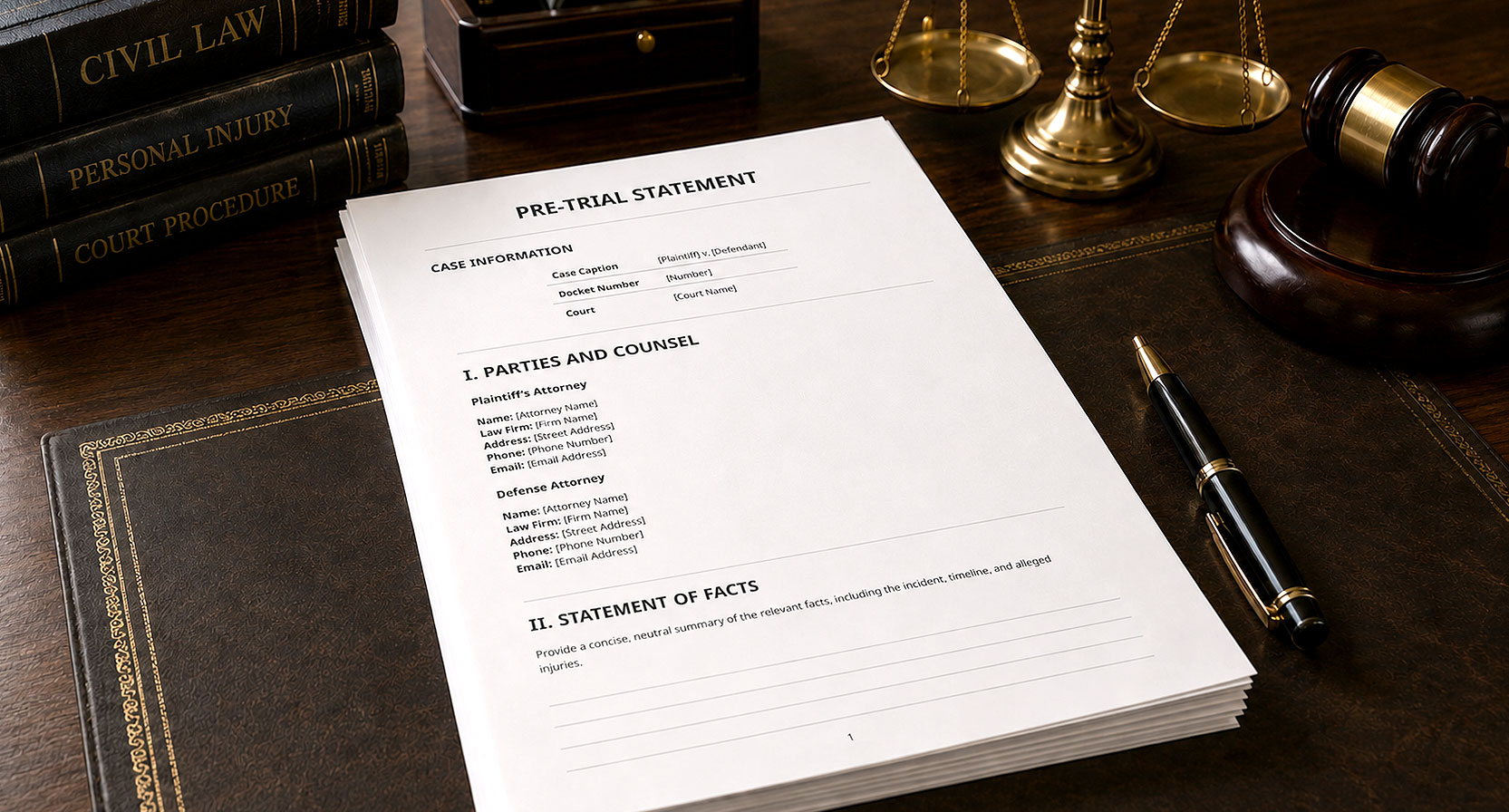
Most personal injury cases never reach a jury. But when a case gets close to trial, one document can shape the outcome more than any other. That document is the pre-trial statement.
This guide explains what a pre-trial statement is, why courts require it, and what belongs in each part. You will also find a simple pre-trial statement template you can adapt for your personal injury case summary, plus a glossary of terms you will see in court forms and local rules.
What Is a Pre-Trial Statement in a Personal Injury Case?
A pre-trial statement is a written report you give to the court before trial. It lays out the statement of facts, the statement of liability, the damages you seek, and the evidence you plan to present. Courts also refer to it as a pretrial memorandum, a pretrial brief, or a pretrial conference statement, depending on the court.
Some courts want each side to file its own civil pretrial statement. Other courts want both sides to work together and file one joint pretrial statement. Either way, the goal is the same. It tells the judge what the case is about and what still needs to be decided.
A pre-trial statement is not the same as a demand letter template or a settlement conference statement. A demand letter goes to the insurance company before a lawsuit is filed. A settlement conference statement, sometimes called a mediation statement, is used during settlement talks or alternative dispute resolution (ADR). A pre-trial statement is filed with the court itself, often close to the trial date.
Why the Pre-Trial Statement Matters
A strong pre-trial statement does more than fill a form. It can change how a case ends.
Judges use it to assess how ready both sides are for a jury or bench trial. It helps them plan the court scheduling conference, guide jury selection, and set the estimated trial length. A clear, well-organized statement also tells the judge which side has done its homework.
Insurance companies pay attention too. When an insurance adjuster or claims examiner sees a strong, detailed statement, they know the case is ready for court. That pressure often raises the settlement value of the claim. A weak or late statement can have the opposite effect.
There is also a real risk if you leave something out. In most courts, if you do not list a witness, an exhibit, or a disputed issue of fact in your statement, you may lose the right to raise it at trial. This is one of the most important reasons to take the document seriously.
When and Where a Pre-Trial Statement Is Required
Courts order a pre-trial statement at or before the final pre-trial conference. Rules differ across courts, so always check the local rules for your case.
In federal court, the main rule is FRCP Rule 16 of the Federal Rules of Civil Procedure (FRCP). This rule allows a U.S. District Court judge to call a pretrial conference to speed up the case, reduce wasted work, and improve the quality of the trial. FRCP Rule 16 also governs the scheduling order, which sets deadlines for adding parties, amending pleadings, completing discovery, and filing motions. A schedule can only change for good cause, meaning the party asking for more time acted with reasonable speed. You can read the full rule through the Legal Information Institute (Cornell LII), a free source for federal law.
State courts have their own versions of these rules. For example, Michigan uses State civil procedure rules (e.g., MCR 2.302). Other states run their pretrial process through a State Circuit Court or a Superior Court. The Massachusetts Trial Court and the North Dakota Court System each publish their own pretrial rules online, and the D.C. Courts also post local forms.
In Texas, personal injury cases most often move through a Texas district court, and the pretrial process is governed by Texas Rule of Civil Procedure 166. This rule lets the judge call a pretrial conference to review the statement of facts, set a discovery deadline, confirm stipulated facts, exchange witness lists, and review the proposed jury instructions before the case goes to trial. A case may be handled by a District Judge or a Magistrate Judge, and paperwork is usually filed with the Clerk of Court.
Missing the deadline can hurt your case. Courts can impose sanctions, exclude evidence, or even dismiss claims against a party that fails to prepare or file on time. Keep in mind that the pretrial statement deadline is separate from the statute of limitations, which is the time limit for filing the lawsuit itself. Missing that earlier deadline can end a claim before it ever reaches a pretrial conference.
Other Federal Rules You May See Referenced
Federal cases often cite other rules governing pretrial work in addition to FRCP Rule 16. FRCP Rule 26 covers general discovery duties. Inside it, FRCP Rule 26(a)(1) lists the initial disclosures each side must share early on, and FRCP Rule 26(a)(2) covers expert witness disclosure, the written report an expert must give before testifying. FRCP Rule 37 allows a judge to impose sanctions when a party violates the discovery rules. FRCP Rule 40 covers how a case gets placed on the trial calendar. FRCP Rule 42(b) lets a judge split a trial into separate parts. FRCP Rule 50(a) and FRCP Rule 52(c) allow a judge to decide part of a case without sending it to the jury when the evidence points only one way.
The Federal Rules of Evidence matter here, too. Federal Rule of Evidence 502 protects certain private legal documents even if they are shared by accident. Federal Rules of Evidence 702, 703, and 705 govern when and how an expert witness may testify at trial.
These modern pretrial rules grew out of years of study, including work from groups such as the National Commission for the Review of Antitrust Laws and Procedures, which helped shape how the U.S. Courts system manages civil cases today.
Quick Glossary of Terms You Will See in a Pre-Trial Statement
Legal forms are full of short terms that pack a lot of meaning. Here is a plain-English glossary to help you move through the process.
| Term | What It Means |
| Pretrial order | The judge’s written order after a pretrial conference. It lists what was agreed to and decided. |
| Proposed pretrial order | A draft order that the parties write and send to the judge for approval. |
| Final pretrial order | The last version of the order was signed and filed just before trial. |
| Pretrial disclosure form | A form used to share witness and exhibit information before trial. |
| Sample pretrial statement | A model or example statement is used as a guide when writing your own. |
| Stipulation of facts | Facts both sides agree are true do not need to be proved at trial. |
| Undisputed facts | Facts that neither side is arguing about. |
| Stipulated facts | Another term for facts both sides accept. |
| Proposed jury instructions | The rules of law that each side wants the judge to read to the jury. |
| Trial readiness checklist | A list used to confirm that all steps are done before the trial starts. |
| Discovery deadline | The date by which all fact-finding must be finished. |
| Discovery plan | A written plan for how discovery will happen and when. |
| Meet and confer | A required talk between both sides’ lawyers to plan discovery. |
| Initial disclosures | In the first round of information, both sides must share without being asked. |
| Requests for admission | Written questions asking the other side to agree that certain facts are true. |
| Interrogatories | Written questions on one side for the other to answer under oath. |
| Requests for production | A written request for documents or other evidence. |
| Depositions | Sworn, recorded interviews taken before trial. |
| Voir dire | The process of picking a fair jury involves asking jurors questions. |
| Motion in limine | A request asking the judge to allow or block certain evidence before the trial starts. |
| Dispositive motion | A motion asking the judge to decide part or all of the case without a trial. |
| Summary judgment motion | A specific dispositive motion arguing that there is no real dispute left to try. |
| Case management conference | An early court meeting to set the pace of the case. |
| Pretrial report | A detailed internal report that attorneys or insurers write to evaluate a case before the pretrial conference. |
The People Involved in a Personal Injury Pre-Trial Statement

Every pre-trial statement names the people and roles connected to the case.
The person who was hurt and files the lawsuit is the Plaintiff. The person or company being sued is the Defendant. Each side usually has a lawyer. The Plaintiff’s Attorney, sometimes called plaintiff’s counsel, represents the injured person. The Defense Attorney, or defense counsel, represents the person or company being sued. Both may be referred to together as trial counsel.
Some people handle their own cases without a lawyer. This is called being a self-represented party.
On the insurance side, an Insurance Company usually pays the claim if the defendant is found responsible. The company assigns a Claims Adjuster, also called an insurance adjuster, to review the claim and, with the defense team, decide on a defendant’s trial strategy.
The statement also lists who might speak at trial. An expert witness provides testimony based on training, such as a doctor explaining an injury. A Fact Witness, also called a lay witness, describes what they personally saw or experienced, such as a bystander at the accident scene. If money is owed to a doctor or hospital from the case, that person or company is a lien holder.
If the case does not settle, it may go before a Jury or a Trial Judge alone. Some cases use a Mediator or an Arbitrator to try to settle the dispute outside of court, as part of alternative dispute resolution (ADR).
Required Sections of a Personal Injury Pre-Trial Statement
Below is a section-by-section walk-through you can use as a pretrial statement form or a personal injury case summary template.
1. Case Caption and Parties
Start with the case caption, the docket number, and the names and contact details for each Plaintiff and Defendant, along with their lawyers.
2. Statement of Facts
Write a short, clear, and fair account of what happened. Stick to facts such as the date, time, and place of the accident. Do not argue your case here. Just tell the story plainly. This section should read like a summary, not a closing speech.
3. Claims and Defenses
List the legal claims being made. In a personal injury case, this might be a negligence claim, a premises liability claim, a product liability claim, a wrongful death claim, or a medical malpractice claim. Also, list any affirmative defenses, and note any counterclaim or cross-claim if one exists. This part connects to the broader areas of civil litigation and tort law.
4. Statement of Liability
Explain the theory of liability. This usually means showing a duty of care, a breach of that duty, and causation connecting the breach to the injury. Lawyers often call this last piece the proximate cause, meaning the breach was closely enough connected to the injury that it is fair to hold the defendant responsible. If more than one party may share blame, the statement may discuss comparative negligence, contributory negligence, or joint and several liability. It should also note the burden of proof, the standard used to determine who must prove what.
5. Undisputed and Disputed Issues
List the facts both sides agree on. Then list the facts still in dispute. Courts want this section short and specific, not a repeat of the full statement of facts.
6. Damages Summary
This section explains what the plaintiff is asking for and why. It often separates economic damages, such as medical expenses, lost wages, loss of earning capacity, and future medical costs, from non-economic damages, such as pain and suffering. Other terms that may appear here include special damages, general damages, compensatory damages, and, in rare cases, punitive damages. For a catastrophic injury, the statement may also address life expectancy and the injury’s permanence. A full damages calculation helps the judge and the other side understand the actual value of the claim, as well as any settlement demand or known policy limits.
7. Witness List
List every fact witness and expert witness who might testify, along with a short summary of what each one will say. Courts often use a separate witness list template for this.
8. Exhibit List
List every document, photo, or other item you plan to use as evidence at trial. Many courts require an exhibit summary form for this part.
9. Settlement Posture
State whether settlement talks have happened, and how far apart the two sides are. This section connects closely to any earlier settlement statement or demand letter.
10. Trial Details
Include the requested estimated trial length, whether it will be a jury trial or bench trial, and any special scheduling needs.
11. Signatures
Both attorneys or the self-represented party sign the statement to confirm that it is accurate and complete.
A Simple Pre-Trial Statement Template
You can copy this outline into a blank document and fill in your case details.
CASE CAPTION: [Plaintiff] v. [Defendant]
DOCKET NUMBER: [Number]
COURT: [Court name]
I. PARTIES AND COUNSEL
Plaintiff’s Attorney: [Name, address, phone]
Defense Attorney: [Name, address, phone]
II. STATEMENT OF FACTS
[Short, neutral summary of the accident and injury]
III. CLAIMS AND DEFENSES
Claims: [Negligence claim, premises liability, etc.]
Affirmative Defenses: [List]
IV. STATEMENT OF LIABILITY
[Duty, breach, causation, comparative negligence, if any]
V. UNDISPUTED FACTS
[List]
VI. DISPUTED ISSUES
[List]
VII. DAMAGES SUMMARY
Economic Damages: [Medical expenses, lost wages, future medical costs]
Non-Economic Damages: [Pain and suffering]
Total Settlement Demand: [Amount]
VIII. WITNESS LIST
[Name, role, summary of testimony]
IX. EXHIBIT LIST
[Number, description]
X. SETTLEMENT POSTURE
[Summary of talks so far, policy limits if known]
XI. ESTIMATED TRIAL LENGTH
[Number of days]
XII. SIGNATURES
How to Draft a Strong Pre-Trial Statement, Step by Step
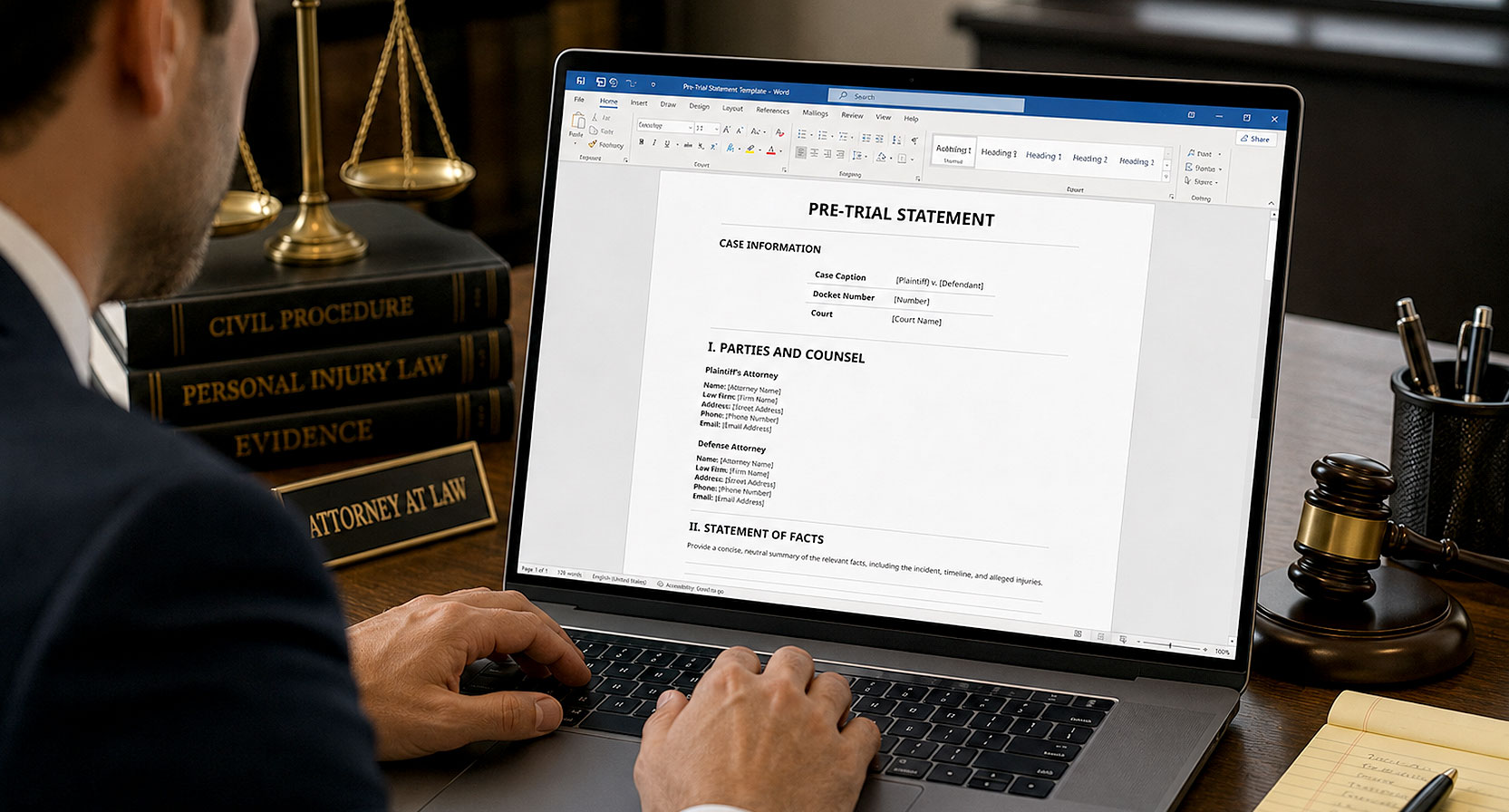
- Gather your case file. Review the Complaint, the Answer, all Discovery Requests, every Deposition Transcript, Medical Records, and the Police Report.
- Write the facts first. Keep the statement of facts clear and in time order.
- Narrow the disputed issues. Only list what truly needs to be decided at trial.
- Support your damages. Back up every dollar amount with bills, pay records, or an expert witness opinion.
- Build your witness and exhibit lists. Do not leave anyone or anything out, since courts may not allow you to add them later.
- Coordinate with the other side if needed. A joint pretrial statement must reflect input from both plaintiff’s counsel and defense counsel.
- File on time. Check the scheduling order and any court-set discovery deadline so your filing meets the rule.
Common Mistakes to Avoid
- Writing the statement of facts as a closing argument rather than a plain summary.
- Leaving out a witness, exhibit, or disputed issue, which can waive your right to raise it later.
- Giving vague damage numbers without proof.
- Ignoring local court rules or a specific court’s own pretrial order requirements.
- Filing late and risking sanctions from the Trial Judge.
Pre-Trial Statement vs. Demand Letter vs. Settlement Statement
| Document | Purpose | Sent To | When |
|---|---|---|---|
| Demand Letter | Asks for payment before a lawsuit starts | Insurance Company | Before filing suit |
| Settlement Statement | Explains the offer or terms of a deal | Other party or Mediator | During negotiation |
| Pre-Trial Statement | Summarizes facts, claims, and evidence for trial | The Court | Before trial |
Frequently Asked Questions
What is the purpose of a pre-trial statement in a personal injury case?
It tells the court and the other side what the case is about, what is agreed on, and what still needs to be argued at trial.
Is a pre-trial statement the same as a settlement statement?
No. A settlement statement is used during negotiation. A pre-trial statement is filed with the court before trial.
What happens if I miss the pre-trial statement deadline?
The court may issue sanctions, exclude evidence, or limit what you can argue at trial.
Do I need a lawyer to file a pre-trial statement?
It is not always required, but a self-represented party often benefits from legal help, since missing a required section can hurt the case.
What is the difference between a joint and an individual pre-trial statement?
A joint pretrial statement is written together by both sides. An individual statement is written and filed separately by each party.
Can I add a witness after filing my pre-trial statement?
Usually not, unless the court allows it for a specific reason. This is why the witness list must be complete before filing.