
Wage Loss Verification Letter: Sample and Template
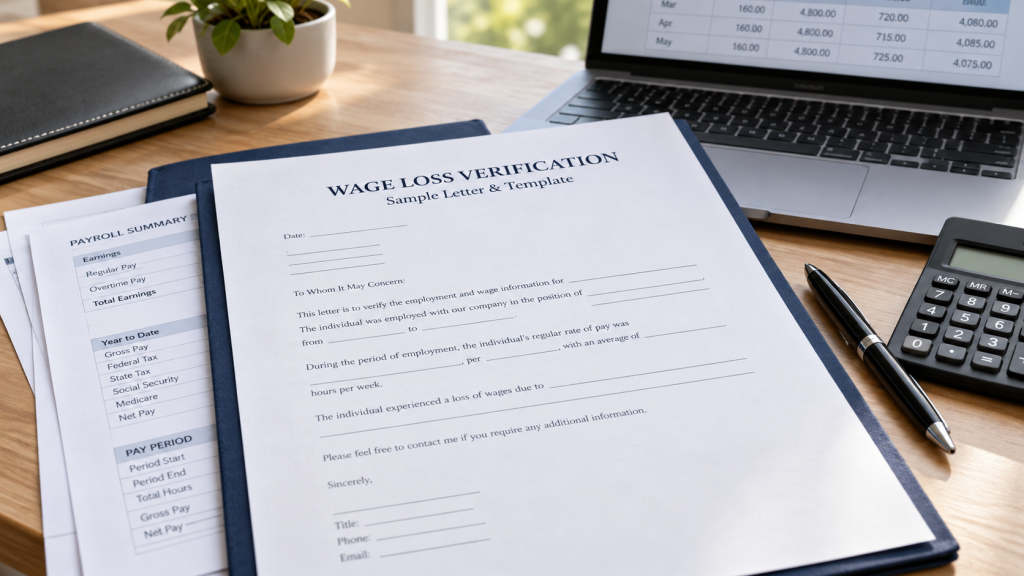
Missing work after an injury can make it hard to pay your bills. To support an insurance claim, you may need proof of lost wages. A wage loss verification letter helps show your pay rate, the work you missed, and the earnings you did not receive.
Your employer, often through the human resources department or payroll department, can check these facts against company records. An insurer’s wage verification form may also ask whether you were paid during your absence or had a wage continuation plan.
This guide provides a wage loss verification letter sample, a blank template, and steps to request the letter. You will also learn how to check the math and gather records that support your claim.
Before using the template, ask your insurance company whether it requires its own form. The letter helps document your loss. The amount you may receive depends on the rules and coverage that apply to your claim.
What Is a Wage Loss Verification Letter?
A wage loss verification letter is a statement from your employer that confirms your pay and the work you missed. It helps an insurance company or claims adjuster review the income you lost after an injury.
Also called a lost wages verification letter or employer statement of lost earnings, it usually includes:
- Your name, job title, and employment dates.
- Your regular pay rate and work schedule.
- The dates and hours you missed.
- The earnings you did not receive.
- Any pay you received while away from work.
- The employer’s signature and contact details.
Insurer forms ask for these details to assess a wage loss claim. Some also request earnings records from before the accident.
How Is It Different From Other Letters?
An employment verification letter confirms your job details. A loss-of-income verification letter also documents missed work and earnings.
A demand letter asks for payment for your losses. The employer’s letter supports that request with payroll facts.
Your employer confirms your work and pay records. Your treating physician documents medical work limits. Ask the insurer whether it needs a wage and salary verification form instead of a letter.
Wage Loss Verification Letter Template
Use this wage loss verification letter template to prepare a draft for your employer. Replace each bracketed field with facts from your work and pay records. An authorized employer representative should check and sign the final letter.
[Company Name]
[Company Address]
[City, State, ZIP Code]
[Business Phone Number]
Date: [Date]
To: [Recipient Name or Claims Adjuster]
[Insurance Company Name]
[Recipient Address]
Re: Lost Wages Verification for [Employee Full Name]
Claim Number: [Claim Number]
Dear [Recipient Name],
This letter confirms that [Employee Full Name] has worked for [Company Name] as a [Job Title] since [Hire Date].
The employee’s regular pay is [$Amount per hour or $Annual Salary per year]. Their normal work schedule is [Hours per Day, Days per Week, and Total Weekly Hours].
Our records show that the employee missed work from [First Date of Absence] through [Last Date of Absence]. This includes [Number] scheduled workdays and [Number] scheduled hours.
[Choose one: The employee returned to work on [Date]. / The employee has not returned to work as of [Date].]
For this period, the employee did not receive [$Amount] in base pay, calculated as follows:
[Pay Rate × Unpaid Hours, or Explain the Payroll Method Used]
Other documented earnings not received were [List Amounts and Explain the Basis, or State “None”].
During the absence, the employee received [List Wages, Paid Leave, or Wage Continuation Payments, or State “None”]. These payments are listed separately from earnings not received.
Attached are [List Supporting Pay and Attendance Records].
This letter confirms facts from our employment and payroll records. Please contact [Representative Name] at [Business Phone Number] or [Business Email Address] with any questions.
Sincerely,
[Signature]
[Representative Name]
[Job Title]
[Company Name]
How to Adapt the Template
For an hourly employee, enter the pay rate and scheduled unpaid hours missed. For a salaried employee, ask payroll to explain any actual pay reduction.
For reduced work hours after injury, list the normal hours, hours worked, and unpaid hours missed. If there were several absence periods, attach a table with each date range.
Keep lost overtime pay, commissions, and bonuses separate from base pay. Use records to support each amount. Insurer forms may ask for prior earnings and pay received during the absence.
What Should a Wage Loss Verification Letter Include?

A clear employer wage loss verification letter should show what you would have earned and what you were paid. Use facts from payroll and attendance records.
Employee and Employer Details
Include your employee name and job title, hire date, and current work status. Add the company’s name, address, and phone number.
Use company letterhead for wage verification when available. Include the claim number so the recipient can match the letter to your file.
Pay Rate and Normal Schedule
State your hourly wage or annual salary. List your normal workdays and hours. Explain whether each amount is gross earnings, before deductions, or net earnings, after deductions.
Missed Work and Lost Earnings
Include:
- The first day absent from work.
- Each date or period of missed work.
- The total workdays missed and scheduled hours missed.
- Your return to work date, if known.
- The pay you did not receive and how you calculated it.
List any supported overtime, tips, or other pay separately. Insurer forms may request earnings from before the accident to help check these amounts.
Paid Leave and Continued Pay
State whether you received paid time off, sick leave, vacation pay, or wage continuation. Keep these amounts separate so the reader can follow the math.
Signature and Contact Details
Add the authorized employer representative’s name, title, signature, and date. Include a business phone number or email for follow-up questions.
Official wage forms also request employee details, absence dates, pay records, and employer confirmation. Check your claim form before sending the letter.
How to Calculate Lost Wages for the Letter
Your total lost earnings calculation should use pay records and scheduled work hours. Show the math so the reader can check each amount.
Hourly Employees
For base pay, multiply your hourly rate by the unpaid hours you missed.
Example: You earn $20 per hour and miss 24 scheduled hours.
$20 × 24 hours = $480 in lost gross wages.
Count scheduled work hours. Do not count weekends or other days you would not have worked.
For a partial wage loss calculation, use the unpaid hours you missed. If you normally work eight hours but worked five, the difference is three hours.
Salaried Employees
A salaried employee’s lost-wages calculation should reflect the actual pay reduction. Ask payroll to explain the method used.
Example: Your regular weekly salary is $1,000. Payroll confirms that you received $600 for a week with unpaid leave.
$1,000 − $600 = $400 in base pay not received.
If your full salary continued, state that fact. Do not list it as unpaid salary.
Overtime, Commissions, Bonuses, and Tips
Support lost commission income, lost bonuses after injury, and lost tips verification with records. Include a shift differential only when the missed shifts would have earned that extra pay.
For variable income verification, explain the period used to find an average. Past earnings can support an estimate, but they do not prove you would have earned every extra payment.
Insurer wage forms may request prior weekly earnings, including overtime, tips, and other pay. Follow the period requested for your claim.
Paid Leave and Wage Continuation
List sick leave used during recovery, vacation time used during recovery, and continued pay separately.
Show both the pay you received and any unpaid amount. Whether you can claim leave you used depends on the rules that apply to your case.
Keep the gross wages lost figure separate from any net income loss figure. The employer’s calculation documents earnings. It does not set the final claim payment.
How to Request the Letter From Your Employer

To request wage verification from your employer, contact HR or payroll. Your direct supervisor may help confirm missed shifts, but ask who can check the pay records and sign the letter.
Follow These Six Steps
- Check with the insurer. Ask your claims adjuster whether you need a letter or a specific form.
- Contact the right department. Ask HR or payroll for a lost wages letter from your employer.
- Share the key details. Provide your claim number, absence dates, and the recipient’s contact details.
- Provide consent if requested. Your employer may ask for employee authorization to verify wages before sharing your records.
- Review the signed letter. Check your name, pay rate, missed hours, and the math.
- Submit it and keep a copy. Follow the insurer’s instructions for sending claim records.
Sample Email to Request a Lost Wages Letter
Hello [HR or Payroll Representative’s Name],
I need a wage loss verification letter to support an insurance claim for work I missed from [Start Date] through [End Date].
Please confirm my job title, hire date, regular pay rate, normal work schedule, and scheduled hours missed. Please also list the pay I did not receive and any wages or paid leave I received during that time.
My claim number is [Claim Number]. I have attached [the insurer’s form or a blank letter template] for your review.
Please include the signer’s name, title, signature, and business contact details. Let me know if you need my written consent or more information.
The requested submission date is [Date].
Thank you,
[Your Name]
[Employee ID, if needed]
What Documents Should Support the Letter?
Your proof-of-lost-wages letter should match your pay and work records. Ask the insurer which supporting documents it needs for lost income.
| Document | What It Helps Show |
| Pay stubs | Your usual pay, deductions, and earnings |
| Payroll register or payroll records | Pay rates and amounts paid during the absence |
| Timesheets | Hours you worked |
| Attendance records | Dates you were absent |
| Work schedules | Shifts and hours you were due to work |
| Form W-2 | Your reported annual wages |
| Federal income tax return | Broader income history, when requested |
| Medical work restriction note | Limits your doctor placed on your work |
| Return-to-work release | When you were cleared to resume work and any limits |
Match the Records to the Claim Period
Use payroll records to verify income and timesheets to document missed work for the dates in your letter. Prior pay records may also help show your normal earnings.
Keep Pay Proof and Medical Proof Separate
Your employer confirms work dates and pay. Your doctor provides medical work-restriction documentation explaining why you could not work or needed fewer hours.
A doctor’s note for missed work does not prove your pay rate. A pay stub does not prove a medical need to miss work. Use each record for the facts it supports.
Send the records requested for your claim. Keep copies of the letter, attachments, and proof of submission.
What If You Are Self-Employed or Your Employer Will Not Provide a Letter?

If you don’t have pay stubs or an employer letter, you may need other records to prove lost income. Ask the insurer which records it will accept.
Self-Employed Workers and Independent Contractors
For self-employed lost-income verification, gather records showing your usual earnings and the work you missed. These may include:
- Tax returns and IRS Schedule C (if used for your business).
- Form 1099-NEC and client payment records.
- Invoices, contracts, and canceled bookings.
- Bank statements and business income records.
- Gig platform earnings reports.
These records can prove lost earnings for independent contractors, document lost freelancer income, or show lost wages for gig workers.
Explain which jobs you could not complete, the dates involved, and how you calculated the loss. A yearly tax form alone doesn’t show why your income fell during a specific week.
Keep business income loss after injury separate from total sales. Business receipts and net profit are different figures. IRS Schedule C records business income and expenses to work out profit or loss. It does not determine your insurance claim payment.
If Your Employer Will Not Provide a Letter
If your employer refuses to verify lost wages, ask whether payroll can provide pay records or confirm basic facts. The employer may be willing to verify your pay rate and absence dates without using your draft.
Ask the claims adjuster for written guidance on alternatives to an employer wage loss letter. Keep copies of your requests and replies.
If missing records delay your personal injury claim, an experienced personal injury attorney can help you review the next steps. Do not assume every employer must issue the same custom letter. Requirements depend on the claim and the applicable rules.
When Do You Need an Official Wage Verification Form?
Before using a letter, ask the insurance company whether it requires a specific form. A general letter may not contain every detail needed for your claim.
Car Accident and No-Fault Claims
For lost wages after a car accident, the required records depend on the claim. Bodily injury liability coverage and personal injury protection may use different forms and follow different rules.
Ask your adjuster which form applies to your lost earnings insurance claim.
Texas Workers’ Compensation Claims
For a Texas workers’ compensation claim, the employer may need to complete Texas DWC Form-003, the Employer’s Wage Statement.
This form records pay, benefits, employment status, and dates of missed work. It also explains how to report earnings from before the injury. It serves a different purpose than a basic car accident claim letter.
For workers with more than one job, the Texas form points to DWC Form-003ME, the Employee’s Multiple Employment Wage Statement. This helps document wages from another employer.
Check the Form Before You Submit
Confirm:
- Which form your claim requires.
- Who completes and signs it.
- Which pay periods it must cover.
- Where and when to submit it.
- Which supporting records to attach.
Use the sample letter when the recipient accepts it. Use the required form when your insurer or claim system calls for one.
Common Mistakes That Can Delay Wage Verification
Check your letter before sending it. Missing information in a lost wages letter can trigger follow-up questions and delay review.
Dates That Do Not Match Your Records
The letter should match your attendance records after injury and work schedule. Count only the shifts or hours you were due to work.
For a part-time employee wage loss letter, use the employee’s actual schedule. For seasonal worker lost earnings verification, show whether the employee was scheduled to work during the absence.
Pay Figures Without Clear Math
State the pay rate, unpaid hours, and calculation method. Do not mix gross earnings with take-home pay.
For a commission-based employee wage loss letter, explain which records support the claimed amount. Avoid adding overtime or bonuses without proof that you missed those earnings.
Leaving Out Pay Received
List any wages, paid leave, or continued pay received during the absence. Insurer forms may ask about these payments as well as prior earnings.
Missing Signatures or Contact Details
Check for the employer’s signature, date, printed name, title, and business contact details.
Treating the Letter as a Payment Promise
The letter supports documentation for a lost-wages settlement. It does not guarantee approval or set the final payment.
If you need help correcting a wage verification letter, ask the employer to issue a revised, signed copy. Do not change a signed letter yourself. If your lost wages claim is denied for lack of proof, ask which facts or records are missing.
Frequently Asked Questions
Who Should Sign a Wage Loss Verification Letter?
An authorized employer representative who can check your work and pay records should sign it. This may be an HR officer, payroll manager, or business owner. Include the signer’s title and business contact details.
Can I Write the Letter for My Employer to Review?
Yes. You can draft it using the wage loss verification letter template. Your employer should check the facts, make any needed changes, and sign the final version.
Does the Letter Need to Be Notarized?
Ask the recipient. Do not assume that every letter needs a notary. The insurer forms cited in this guide request an employer signature without a separate notary section.
Can I Use Pay Stubs Instead of an Employer Letter?
Ask your claims adjuster. Pay stubs for a lost wages claim show earnings but may not show missed scheduled hours. The insurer may also request employer confirmation, attendance records, or its own form.
What If I Used Sick Leave or Vacation Time?
List the leave hours used and the pay received. Keep paid time off used after an accident separate from unpaid wages. Whether you can claim used leave depends on the rules that apply to your case.
What If I Have Not Returned to Work Yet?
State that you have not returned as of the letter’s date. Document missed work through that date. Keep any future estimate separate from earnings already missed. Texas DWC Form-003 includes an option to report that the worker has not returned.
How Do I Document Lost Wages From Multiple Jobs?
Request pay and absence records from each employer. For multiple employer wage verification, show each job’s schedule, missed hours, and lost pay separately.
Texas workers’ compensation has a specific form for wage verification for multiple employers. Other claims may use different records.
Is Lost Income the Same as Loss of Earning Capacity?
Lost wages are earnings missed during a past period. Loss of earning capacity concerns a reduced ability to earn income.
A proof-of-loss-of-income letter can document past pay and absences. It usually cannot, by itself, establish how an injury will affect future earnings.