
Property Damage Demand Letter

A property damage demand letter is a formal document you write when someone else damages your property, and you seek to recover damages. It informs the responsible party of what happened, the amount of the damage, and that you seek payment or repair by a specified deadline. It also explains what might happen if they do not respond or pay. A demand letter like this can help you get compensation without going to court.
This guide will help you, in plain terms, understand what a property damage demand letter is, why it is essential, and how to draft one that is clear and effective. It also includes examples of when you might need one, such as damage caused by a neighbor, a contractor, or an accident.
A demand letter is a key step before more serious action, such as filing in small claims court or contacting an insurance company. It demonstrates you are serious and gives the other party a chance to remedy the problem first.
What Is a Property Damage Demand Letter?
A property damage demand letter is a formal written notice that you send when your residential property, commercial property, vehicle property, or other belongings are harmed, and you want to be paid back. It explains what happened and how much money you want to cover repair cost reimbursement or replacement costs.
In simple terms, it is a way of asking the person or business that caused the damage to take responsibility for the property damage and make things right. It helps you initiate a settlement negotiation and secure payment without going to court.
This letter often includes a clear description of the damage, evidence photos, repair estimates, and a set response deadline. If the other side does not reply or pay by that date, you can take further action, such as legal action or a small claims demand.
In many cases, sending a demand letter is a must before you file a case with a judge or ask an insurance adjuster to step in. The demand letter is used to demonstrate that you attempted to resolve the issue first.
When Should You Send a Property Damage Demand Letter?
You should send a property damage demand letter after your property is damaged or lost, and you know who is responsible. A demand letter is most effective when you seek compensation or reimbursement for repair costs from the person, business, or insurance company responsible for the harm. The goal is to initiate a formal demand before proceeding to more serious steps, such as filing in small claims court or taking legal action.
A good time to send this type of legal notice of damage is:
• Right after the damage is apparent and you have evidence
Send the letter as soon as possible after an event like a car crash, a contractor mistake, a fallen tree from a neighbor’s yard, or other harm to your residential property, commercial property, or vehicle property. Sending it promptly helps preserve evidence and demonstrates your seriousness.
• After you gather repair estimates and proof of costs
Wait until you have an itemized list of damages, photographs, repair invoices, or other documentation of the cost to repair or replace the damaged property. This makes your payment demand clear and complete.
• If the other party has not offered payment or help
If the responsible party has not already agreed to pay or repair the damage, a formal demand letter gives them a chance to respond before you take further action.
• Before filing a lawsuit or small claims case
In many places, sending a pre‑litigation demand letter is a good step before court. Some courts may even require proof that you tried to settle first. A well‑written letter can be an essential part of a civil claim notice and may avoid formal court costs.
• If an insurance claim letter has stalled or been denied
You can also send a demand letter to your insurer or the at‑fault party’s insurance company when your claim is not moving, underpaid, or denied. This type of demand can prompt a fair settlement before legal action.
In all these scenarios, the property damage demand letter serves as strong, documented evidence that explains what happened, the liability for the property damage, the amount you seek, and the response deadline. This helps focus the negotiation and may lead to a fair resolution without going to court.
Key Elements of a Demand Letter
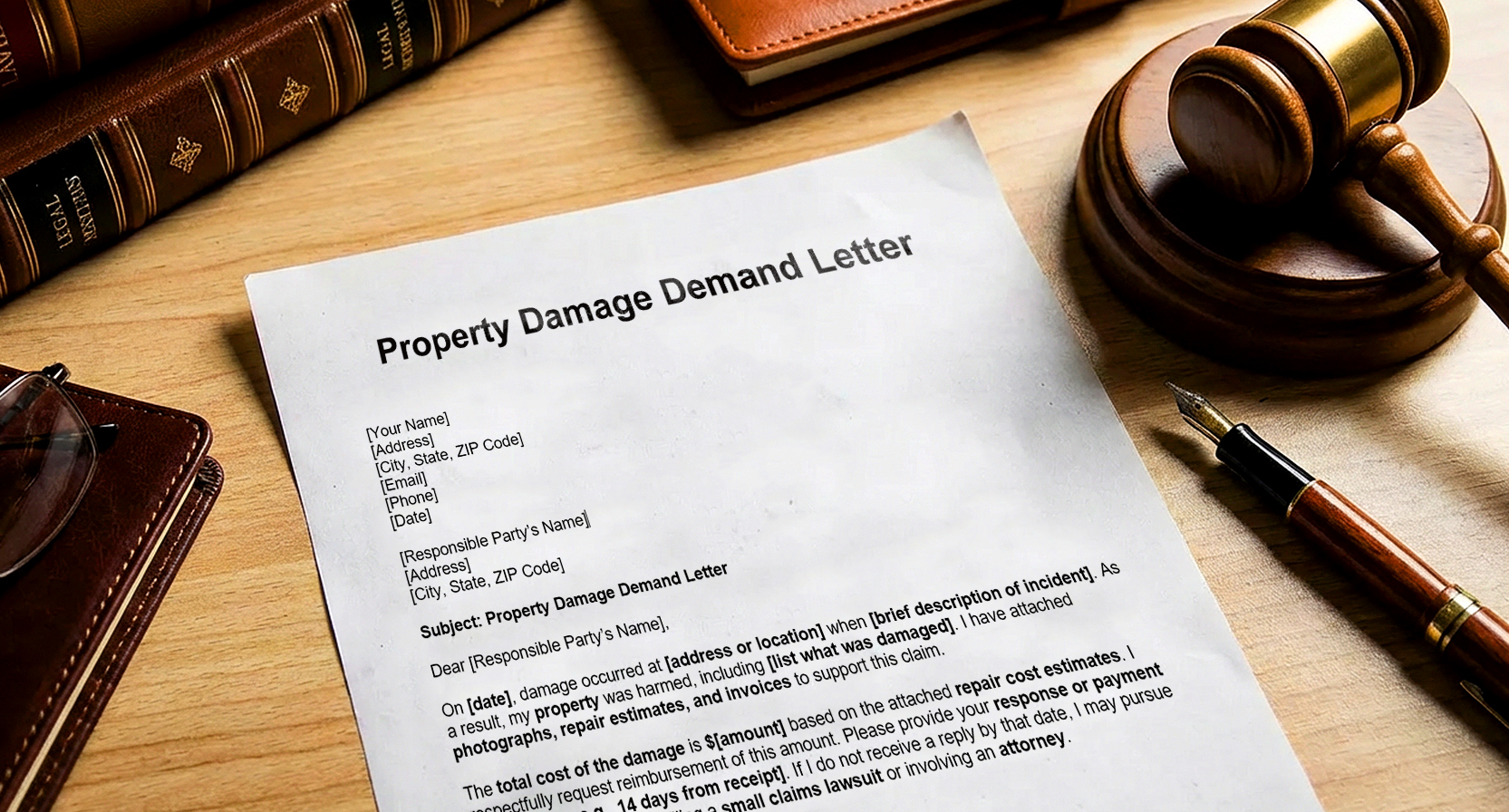
A strong property damage demand letter must include important parts that make your case clear and convincing. This section explains what each part is, so the responsible party, insurance adjuster, contractor, neighbor, or other defendant can understand your claim and the amount you want. A complete letter increases your chances of receiving compensation and can help you avoid small-claims court or legal action later.
1. Your Contact Information and Date
Start with your full name, address, phone, and email. Then write the date you are sending the letter. This shows who is making the formal demand.
2. Recipient’s Contact Information
Include the name and contact details of the person or business you are sending the letter to. This may be the responsible party or their insurance company.
3. Description of the Property Damage
Clearly describe what property was damaged. Say where and when it happened, and what part of your residential property, commercial property, or vehicle property was affected. Be factual and accurate with the details.
4. Facts About How Damage Happened
Write a short statement about how the damage occurred and why the other side is liable for property damage. This part helps the reader understand responsibility and connects it to your demand for payment.
5. Evidence You Attach
List evidence that supports your claim. This may include photographic evidence, repair estimates, repair invoices, appraisal reports, police reports, or incident reports. These help strengthen your damage claim letter.
6. Itemized Cost of Damages
Explain your repair cost reimbursement or replacement cost. Break down the amount you want into simple parts so the total demand is easy to follow.
7. Demand for Payment or Fixing the Damage
State precisely what you want the other party to do. Say you want them to pay a certain amount, fix the damage, or both, within a set response deadline.
8. Deadline for Response
Give a clear timeline for when you expect a reply or payment. Most letters take about 14 days, but you can choose a date that works for you. A clear deadline shows urgency and helps you plan next steps if they do not respond.
9. Consequences if They Do Not Respond
Let the reader know what may happen if they ignore your letter. You may seek legal action, go to small claims court, or involve an attorney. This is not a threat; it is a real next step if no resolution is reached.
10. Signature and Attachments List
End the letter with your signature and a list of all attached documents, such as photos or estimates. This makes sure your letter looks complete and professional.
These key elements help make your property damage demand letter clear, organized, and legally useful. A complete letter demonstrates that you are serious and prepared, and it can lead to a fair settlement without the stress of a lawsuit.
Step‑by‑Step Guide to Writing the Letter
Writing a property damage demand letter means explaining your claim clearly and simply so the responsible party responds. Follow these steps to make your damage claim letter easy to read and strong enough to secure compensation or reimbursement for repair costs.
1. Gather All Your Information First
Before writing, collect key facts about the incident and damage, including photographic evidence, dates, estimates, and receipts. This lets you show the actual loss calculation and the basis for holding the other party liable for property damage.
2. Start With Clear Contact Details
At the top of your letter, write your full name and address, and the name and address of the person or insurance company you are sending it to. Include the date of the demand letter to document when you made the written request for damages.
3. Introduce the Purpose of the Letter
Open your letter with a short sentence that says you are making a formal demand for compensation due to property damage. This part helps the reader instantly know why you wrote the letter.
4. Describe the Damage and Incident
Write a simple explanation of what happened. Include where, when, and how the damage occurred. Say what was damaged, such as structural damage to a home or vehicle damage, and why the other party is responsible. Use plain language so the claimant and defendant understand your case without confusion.
5. Attach or List Your Evidence
Tell the reader that you are including copies of your photographic evidence, repair estimates, repair invoices, police reports, or other documents that back up your demand for payment. This is your evidence documentation, which helps strengthen your damage claim.
6. State the Amount You Want
Write exactly how much money you are asking for. This should be the total of all repair cost reimbursements and replacement costs. You can include an expense breakdown to make it easy to follow.
7. Give a Deadline for Response
Inform the other party how many days they have to respond. A common choice is about 14 days, but you can choose a timeline that suits your case. Set a response deadline so they know when to expect an answer or payment.
8. Explain What Happens Next
Tell them what you will do if they do not reply or pay by the deadline. You may go to small claims court, pursue legal action, or consult an attorney if needed. This part is a clear and truthful note about your next steps, not a threat.
9. Close With Your Signature
End the letter with your printed name, your signature, and your contact information. List all attachments (e.g., photos and invoices) at the end to ensure nothing is missed.
10. Send the Letter Carefully
After writing, send your letter so you can prove it was received, such as via tracked mail or email. Keeping proof helps if you later need to show the letter in court or in a negotiation.
Following these steps makes your demand letter clear, professional, and focused on settlement negotiation before you consider court or further legal steps.
Sample Demand Letter Templates
Below are clear sample templates you can use or adapt for your own property damage demand letter. These templates help you format your claim correctly and ensure you include the key elements: a clear description of the damage, costs, the deadline, and supportingevidence. Hence, the responsible party, insurance adjuster, or neighbor understands your request.
Simple Sample Template (General Case)
This is a plain template you can use for most kinds of property damage:
[Your Name]
[Address]
[City, State, ZIP Code]
[Email]
[Phone]
[Date]
[Responsible Party’s Name]
[Address]
[City, State, ZIP Code]
Subject: Property Damage Demand Letter
Dear [Responsible Party’s Name],
On [date], damage occurred at [address or location] when [brief description of incident]. As a result, my property was harmed, including [list what was damaged]. I have attached photographs, repair estimates, and invoices to support this claim.
The total cost of the damage is $[amount] based on the attached repair cost estimates. I respectfully request reimbursement of this amount. Please provide your response or payment by [deadline, e.g., 14 days from receipt]. If I do not receive a reply by that date, I may pursue further action, including filing a small claims lawsuit or involving an attorney.
Sincerely,
[Your Signature]
[Your Printed Name]
Neighbor Property Damage Template
Use this when a neighbor’s action (like a fallen tree) damaged your residential property:
[Your Name]
[Address]
[City, State, ZIP Code]
[Phone | Email]
[Date]
[Neighbor’s Name]
[Address]
Subject: Demand for Reimbursement — Property Damage
Dear [Neighbor’s Name],
I am writing about the incident on [date] when your [e.g., tree] fell on my property at [your address]. The damage includes [e.g., fence and landscaping], and I have included photos and a repair estimate.
Because your property caused this damage, I request reimbursement of $[amount] for repair costs within [number of days] days of receipt of this letter. If I do not hear from you by then, I may pursue legal action or file a small claims action to protect my rights.
Thank you for your prompt attention to this matter.
Sincerely,
[Your Name]
Vehicle or Accident Damage Template
This works for cars or other vehicle property damage claims:
[Your Name]
[Address]
[City, State, ZIP Code]
[Phone | Email]
[Date]
[Recipient/Insurance Company Name]
[Address]
Subject: Demand for Payment for Vehicle Property Damage
Dear [Recipient’s Name],
On [date], my vehicle was damaged at [location] when [brief description of event]. The total repair cost is $[amount], based on the attached estimates and invoices. I request payment of this amount by [deadline].
I have included evidence for your review. Please respond with how you will satisfy this damage claim. If I do not receive a response, I may pursue settlement negotiations through legal channels.
Sincerely,
[Your Name]
Tips When Using Templates
- Write clearly and avoid legal jargon so the other party can easily understand your demand.
- Attach evidence, such as photos, police reports, or repair estimates, to your letter.
- Always keep a copy of your letter and send it in a way that you can prove it was delivered.
How to Send a Demand Letter and What Happens After You Send It

After you draft your property damage demand letter, the next step is to send it to confirm receipt and plan next stepsif they do not respond or disagree. It is essential to send it correctly so you have records if you need to take legal action later.
How to Send Your Demand Letter
Use Certified Mail With Tracking
Send your payment request via certified mail to obtain a delivery receipt showing the date of delivery. This helps prove that you sent the letter and that the other party received it.
Keep a Copy of Everything
Make sure you keep a copy of your property damage demand letter, photographic evidence, repair cost estimates, and all delivery records in your files. These records can support your case in small claims court or in settlement discussions later.
Consider Additional Delivery Methods
Some people also send a regular mail copy or an email copy. Certified mail provides legal proof, while email can expedite the process once the responsible party receives your letter.
After You Send the Demand Letter
Wait for the Response
Once the demand letter is delivered, wait until the response deadline you included in the letter. Most people or companies will respond within that timeframe.
Possible Outcomes
- The other party may agree and pay what you asked for, or start a settlement negotiation.
• They might ask for more information or offer a counteroffer.
• They could deny your claim.
• They may not reply at all by the deadline.
What to Do if They Do Not Reply or Disagree
Follow Up
If they do not respond by your deadline, you can follow up with a phone call, a second demand letter, or request a meeting to negotiate.
Consider Filing a Small Claims Lawsuit
If your compensation demand is ignored or rejected, the next step is often to file a claim in small claims court. Many courts require that you first try to settle with a demand letter before you file a case, and your proof of sending the letter can help your claim.
Prepare for Negotiation or Court
If the other side responds but disputes the amount or responsibility, you may enter a settlement negotiation. If that fails, you may prepare for formal legal action, like filing a court claim for compensatory damages or taking your case to a judge.
Key Tips for Sending and Following Up
- Sending by certified mail gives you the best proof of delivery.
• Keep all copies and communication in a safe case file.
• Plan your next steps early, especially if you think you may need to go to small claims court or take legal action.
What Happens After You Send Your Demand Letter
After you send your property damage demand letter, several steps may follow. This section explains what to expect, why each step matters, and how to proceed if you do not receive a clear response. The goal is to help you manage your damage claim wisely and plan the next steps.
Response from the Other Side
When the responsible party or their insurance company gets your demand for payment, they might respond in different ways:
• They may agree and pay the amount you asked for.
• They may offer a counteroffer with a lower amount or different terms.
• They may ask for more information or proof before deciding.
• They might deny the claim or disagree with your calculations.
• They might not reply at all by your deadline for response.
A well‑written demand letter that includes repair estimates, photographic evidence, and a clear, itemized list of damages increases the likelihood of a response and a settlement.
Negotiation and Settlement
Often, the other party will initiate settlement negotiations after your letter. They may call you or send their own letter with changes. In this stage:
• You can accept a reasonable offer.
• You can negotiate terms like the amount, payment timeline, or how repairs will be handled.
• You can also involve an attorney / legal counsel to help.
Good negotiation can resolve your case without needing a formal court case, saving time and legal fees.
No Reply or Disagreement
If the person or insurance adjuster does not reply by your deadline, or if they reject your terms, you still have options. Many people then choose to:
• Send a second demand letter or follow‑up.
• Prepare to file a claim in small claims court or another legal venue.
• Consult an attorney for advice on legal next steps.
Sending a demand letter first often shows good faith and can help your case if it later goes to court.
Preparing for Legal Action
If negotiation does not work, you may prepare for legal action, such as a small claims lawsuit. In many places, courts look at your demand letter as evidence that you tried to solve the issue before asking a judge to decide.
At this stage, you should:
• Keep all copies of the letter and delivery proof.
• Organize all supporting evidence like photos, repair invoices, and cost estimates.
• Decide if you will represent yourself or hire an attorney.
In short, your demand letter initiates a process that can lead to a settlement, a simple payment, or legal action. Understanding these steps can help you make informed decisions as your case progresses.
FAQs (Frequently Asked Questions)
What is a property damage demand letter?
A property damage demand letter is a formal written request that tells the person or business who caused the damage that you want compensation or repair for the harm to your residential property, commercial property, or vehicle. It explains what happened, describes the damage, and outlineshow much money you want. This written notice helps initiate settlement negotiations and can be used before taking legal action.
Why should I send a demand letter before going to court?
Sending a demand letter shows you tried to solve the problem first. Many courts accept a case only after you show that you asked for payment or repair in writing first. A clear demand letter can help you avoid a lawsuit by encouraging the other side to agree or make a counteroffer.
When should I send a property damage demand letter?
Send the letter soon after your property is damaged, once you have your itemized damage list and repair cost estimates. Acting quickly also helps preserve evidence, such as photographs and incident reports, which strengthens your claim.
What should a demand letter include?
A good damage claim letter should include:
• Your contact info and the responsible party’s name
• Date and location of the damage
• Clear description of the damage and how it happened
• Repair estimates, photos, invoices, or other proof
• The exact amount you want and a deadline for response
• A note about what will happen if they don’t reply (like small claims court)
Can I write it myself, or do I need a lawyer?
You can write a property damage demand letter yourself. Many people do it without legal help, especially for smaller claims. If the damage is significant, complex, or likely to end up in court, an attorney / legal counsel can review your letter to ensure it is strong and compliant with legal rules.
How long should I give the other side to respond?
A common choice is about 14 days from receipt of the letter, but you can choose a longer or shorter time based on your situation. Setting a written response deadline shows urgency and moves the negotiation forward.
What happens if they ignore the demand letter?
If the responsible party does not respond by the deadline, you can:
• Send a follow‑up letter
• Start a small claims lawsuit
• Take other legal action if needed
Keeping the first letter and delivery records can help you later in court.
Is a demand letter legally required?
No. Demand letters are usually not legally required, but courts often expect you to try resolving the issue first before forcing a judge to decide. Sending one creates a record and demonstrates that you acted in good faith to fix the problem without going to court.
Can this letter be used for car, home, or business property damage?
Yes. You can use a property damage demand letter for any type of property damage. Just change the facts, amounts, and attached repair estimates or photos to match your case.